

Does Homeowners Insurance Cover Wind Damage to Roofs?
The short answer is yes. Most homeowners policies cover wind damage to roofs, and in some cases a roof can be fully replaced even when the visible damage looks minor. The longer answer is that whether and how much your insurer pays depends on your shingle type, your specific policy, your state, and how well the damage is documented. This article is general information, not insurance advice. Your carrier and its adjuster make the final call on any claim.

Your Shingle Type Changes Everything
Before anything else, the kind of shingle on your roof heavily influences how a wind claim plays out.
T-lock shingles. These interlocking, T-shaped shingles were common across the Front Range and Rocky Mountain West for decades, but manufacturers stopped making them around 2004. Because no one produces them anymore, a damaged T-lock roof cannot be repaired with matching material. The result is that even modest wind damage, a single tear or crease, often leads an insurer to replace the entire roof, since there is no way to patch it properly. We still see this regularly in Wyoming and Colorado.
Three tab shingles. The older, flat, single layer style is the most prone to wind uplift. Standard three tab shingles typically carry a wind rating of around 60 miles per hour, and as they age they grow brittle and lift more easily. Missing tabs and creased shingles after a windstorm are common.
Architectural shingles. The thicker, dimensional shingles most homes use today are far more wind resistant, generally rated from 110 up to 150 miles per hour. Owens Corning Duration, a popular entry level option, carries a 130 mile per hour rating. In high wind areas like much of Wyoming, a six nail application is important, both because local code often requires it and because it is needed to qualify for the full wind warranty on many products. For value focused markets, a six nailed Duration is a common pick because it hits that wind rating affordably, even if a more hail resistant shingle exists.
What Counts as Wind Damage
Adjusters look for physical evidence that wind lifted or tore the roofing: creased shingles, torn or missing shingles, and similar storm related damage. How much is needed to trigger a repair versus a full replacement varies a great deal by carrier and by state.
For T-lock, a single area of damage is often enough, for the matching reason above. For three tab and architectural roofs, the bar is higher and the rules differ by location. Some carriers and states look for damage spread across multiple slopes before approving a full replacement, and the percentage and per slope requirements vary. Wind claims are also generally harder to prove in Colorado than in Wyoming, in part because Colorado sees so much hail that hail claims are far more common than wind claims here.
The takeaway is not a fixed formula. It is that the threshold depends on your policy and your insurer, so it is worth having a professional document the damage thoroughly.
Documenting a Wind Claim
Wind damage is easier to support when you can tie it to a specific storm. Tools like HailTrace and other hail and wind maps help, and you can often find a National Weather Service report showing wind speeds at or above your shingle's rating around the time of the damage. Most carriers give you a window to file a wind claim, often one to two years, but that varies by policy, so check yours.
One wrinkle: microbursts, which are intense, localized downdrafts, can do serious damage and may never show up on a regional weather map. That makes professional documentation even more important when the official record is thin.
A note on wind speed. Manufacturer ratings are lab maximums for a properly installed, well sealed roof. A healthy roof should not lose shingles in an ordinary 30 mile per hour breeze, but an aged roof with broken seals can fail at lower speeds. The National Weather Service classifies winds of 58 miles per hour or higher as severe.
Why Wind Uplift Is Sneakier Than It Looks
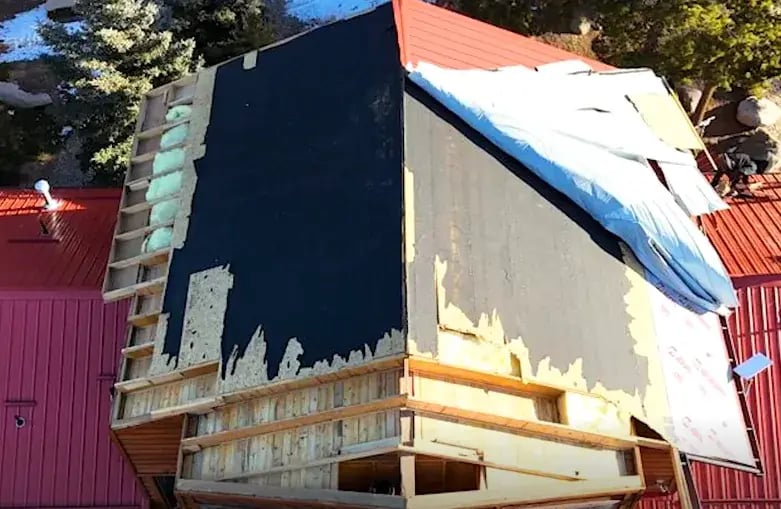
Wind does not just push on a roof, it lifts it. As wind hits a house, it is forced upward and accelerates, so a 60 mile per hour wind at ground level can translate into much stronger uplift forces by the time it curls over your roof. Those forces concentrate at the edges and corners, which is exactly why building codes call for more fasteners there. This is not just a shingle issue. We have seen entire tile roofs lifted off in the high wind zones around Superior, Colorado, where heavy concrete tiles, ten to twelve pounds each, became dangerous projectiles. On a metal roof job in Conifer, wind tore off not only the metal panels but the entire roof system beneath, landing pieces a couple hundred feet away in the trees. Flat roofs are especially vulnerable to uplift at the perimeter and corners, which is why those areas get extra fasteners or, on ballasted systems, larger river rock around the edges. Engineers use specific uplift equations to spec these out.
If You Lose Roof Cover in a Storm
If a windstorm strips part of your roof, the priority is keeping water out before the next rain. Get a tarp, or better yet heavy industrial sheeting, secured over the opening as fast as possible, ideally by a contractor. An exposed roof deck during a rainstorm turns a wind claim into a far more expensive water damage problem.
Let Excel Roofing Help You Through It
Wind claims hinge on documentation and on knowing what your carrier is looking for. We inspect the roof, document the damage properly, and help you understand your options, whether that is a repair or a full replacement.
At Excel Roofing, we have been handling storm damaged roofs across the Denver metro, Colorado Springs, Casper, and Sheridan since 1993. We are on top of it, and you do not pay a cent until you are content.
Sources
-
Klaus Roofing Colorado, T-Lock Roofing Shingles Are Discontinued: https://klausroofingcolorado.com/roofing-blog/t-lock-roofing-shingles discontinued/
-
CGR Wholesale Roofing, What Wind Rating Do Owens Corning Shingles Have: https://www.cgrwholesaleroofing.com/post/what-wind-rating-do-owens-corning shingles-have
-
Insurance Institute for Business and Home Safety, Wind Uplift of Asphalt Shingles: https://ibhs.org/wp-content/uploads/member_docs/Wind-Uplift-of-Asphalt Shingles_IBHS.pdf
Topics:
