
Complete Guide to Residential and Multifamily Gutter Systems
August 24th, 2026
20 min read
The Complete Guide to Residential and Multifamily Gutter Systems: Sizing, Materials, Installation, and Drainage
Updated 8/24/2026
Gutters look simple. A trough collects water from the roof, downspouts carry it to the ground, and the system keeps water from dumping directly around the building.
In practice, a properly designed gutter system is considerably more complicated.
The gutter itself is only one component of a roof-drainage system that includes the roof surface, valleys, drip edge, fascia, gutter profile, gutter size, outlets, downspouts, elbows, extensions, underground drainage where applicable, and the final discharge location.
A gutter can be perfectly straight and visually clean and still perform poorly if it is undersized, positioned incorrectly, given inadequate downspout capacity, or discharges water in the wrong location.
Since 1993, Excel Roofing has worked on roofing and exterior systems ranging from standard single-family homes to luxury residences, multifamily buildings, townhome communities, HOAs, and large residential projects. Over that time, we have completed thousands of gutter installations, both as standalone projects and as part of larger roof and exterior replacements.
That field experience has shaped a relatively simple philosophy: a gutter system should be designed around the amount of water the roof is actually going to deliver to it.
For many properties, that leads us toward 6-inch metal gutters with appropriately sized downspouts. But there is no single gutter size, material, or profile that is correct for every building.
This guide explains how we evaluate those decisions.
What Proper Gutter Installation Actually Looks Like
Professional gutter installation starts before a gutter machine is ever turned on.
The first question should not be, "What color gutters do you want?"
It should be:
How does water move across this roof, and where should that water ultimately go?
1. Evaluate the Roof Drainage Area
The amount of water reaching a gutter depends on more than the linear footage of the eave.
Important factors include:
- Total roof drainage area
- Roof pitch
- Roof geometry
- Valleys
- Dormers
- Intersecting roof sections
- Long eaves
- Concentrated drainage points
- Local rainfall intensity
- Available downspout locations
A simple gable roof can be relatively straightforward. A large home with multiple roof planes and valleys is different.
Valleys are particularly important because they concentrate water from multiple roof surfaces into relatively small areas of gutter.
During an intense thunderstorm, a gutter may perform adequately across most of a roof while becoming overwhelmed directly below a major valley.
That is why gutter sizing cannot be evaluated by looking only at the length of the gutter.
2. Select the Gutter and Downspout Sizes Together
Increasing gutter size without providing enough outlet and downspout capacity can simply create a larger container that still cannot drain quickly enough.
The gutter collects the water.
The outlets and downspouts have to evacuate it.
A professional system therefore considers:
- Gutter size
- Gutter profile
- Outlet dimensions
- Downspout dimensions
- Number of downspouts
- Location of each downspout
- Length of gutter being drained
- Concentrated roof drainage
- Elbows and changes in direction
- Final discharge location
This is one reason Excel Roofing frequently recommends 6-inch gutters paired with larger downspouts on properties where the roof geometry and drainage volume justify the additional capacity.
3. Establish High Points, Low Points, and Gutter Pitch
A gutter needs enough slope to move water toward its outlets without creating a visibly crooked installation.
Too little pitch can leave standing water.
Too much pitch may be visually obvious and can create problems with gutter positioning along the roof edge.
There is no single slope that should blindly be applied to every installation. Profile, run length, outlet configuration, manufacturer guidance, architectural conditions, and project specifications all matter.
The important point is intentional drainage.
The installer should know where the high point is, where the low point is, which outlet is serving the run, and why the gutter is pitched in that direction.
Long runs may be divided so water drains toward outlets at opposite ends rather than forcing the entire run toward one downspout.
4. Position the Gutter Correctly at the Roof Edge
The relationship between the roof edge, drip edge, fascia, and gutter matters.
Water leaving the roof needs to enter the gutter rather than run behind it or overshoot it.
Problems can occur when gutters are installed:
- Too low
- Too high
- Too far away from the roof edge
- Improperly behind or beneath roof-edge components
- Without considering shingle overhang
- Without accounting for high-volume valley discharge
The roof edge and gutter should function as one drainage detail.
5. Inspect the Fascia Before Installation
A gutter is only as secure as the material supporting it.
Rotten, deteriorated, loose, or improperly installed fascia should not simply be covered with a new gutter.
Fasteners and hangers need to engage structurally appropriate material for the particular assembly. The correct attachment method depends on the fascia construction, framing, gutter material, expected loads, manufacturer requirements, and building conditions.
This becomes especially important with heavier gutter systems and in areas subject to snow and ice.
6. Use Appropriate Hanger Spacing
Hangers support the gutter and help it resist water loads, snow, ice, wind, and physical movement.
Excessive hanger spacing can allow gutters to sag, twist, pull away from the fascia, or lose their intended pitch.
There is no responsible universal hanger-spacing number for every gutter system. Material, gutter size, hanger type, fascia construction, snow conditions, and manufacturer requirements all matter.
As one example of how material-specific these requirements can become, Copper Development Association architectural specifications call for copper gutter supports at relatively close intervals in applicable systems and specifically note that closer spacing may be necessary for additional loads.
The correct spacing should therefore be designed for the actual system rather than copied from a generic rule of thumb.
7. Build Clean, Watertight Corners and Joints
Inside corners, outside corners, end caps, outlets, and seams are common failure points.
Good gutter work requires:
- Accurate cuts
- Properly formed miters
- Correct overlaps
- Compatible sealants
- Proper fastening
- Clean outlet fabrication
- Material-specific joining methods
- Allowance for thermal movement where required
A poor miter can turn into a recurring leak even when everything else about the gutter is correct.
8. Design the Downspout Route
The job is not finished when water reaches the bottom of a downspout.
Water still needs somewhere to go.
Downspouts may require:
- Elbows
- Extensions
- Splash blocks
- Kick-outs
- Connections to approved underground drainage systems
- Routing around architectural features
- Routing away from entrances and walkways
Dumping hundreds of gallons of roof runoff directly beside the foundation defeats much of the purpose of installing gutters in the first place.
A gutter is therefore not simply metal attached to fascia.
It is a water-management system.
Why Excel Roofing Often Recommends 6-Inch Gutters
Five-inch K-style gutters have been installed successfully on residential properties for decades. There are plenty of buildings where a properly designed 5-inch system is adequate.
However, when we are designing a new system and the property can reasonably accommodate either size, Excel Roofing frequently recommends 6-inch gutters.
The reason is additional drainage capacity.
5-Inch vs. 6-Inch Gutters
Moving from a 5-inch to a 6-inch gutter increases more than the visible width of the gutter. The larger profile provides additional cross-sectional area and can generally accept substantially more roof runoff, particularly when combined with appropriately sized outlets and downspouts.
That additional margin can be useful for:
- Larger roof areas
- Steeper roofs
- Complex roof geometry
- Large valleys
- Intense thunderstorms
- Long gutter runs
- Large custom homes
- Multifamily properties
- Areas where several roof planes concentrate water into one location
A steep roof does not create more rainfall, but it changes how quickly runoff can reach the eave. Likewise, valleys can deliver a large volume of water to a relatively narrow section of gutter.
That is often where additional capacity becomes valuable.
Why Build Additional Capacity Into the System?
Gutters do not usually fail during a light rain.
Their limitations become apparent during the conditions that stress the drainage system.
If a property can accommodate a larger gutter without creating an architectural problem, we generally prefer having additional drainage capacity rather than designing a system too close to its practical limit.
The visual difference between many 5-inch and 6-inch systems is relatively modest, particularly on larger homes. On the right property, the performance advantage is worth that difference.
That does not mean every house needs 6-inch gutters.
Proper gutter sizing should consider:
- Roof drainage area
- Roof pitch and geometry
- Rainfall intensity
- Valley locations
- Gutter profile
- Downspout capacity
- Available outlet locations
- Architectural appearance
- Manufacturer requirements
- Project-specific engineering or code requirements where applicable
For a small, straightforward roof, a 5-inch system may perform perfectly well.
For a large or complex property, the additional capacity of a 6-inch system can be a worthwhile upgrade.
K-Style vs. Half-Round Gutters
Gutter size is only one decision. Profile also affects appearance, installation, material options, and sometimes drainage characteristics.
The two profiles we encounter most frequently on residential properties are K-style and half-round.
K-Style Gutters
K-style gutters are the dominant profile on many American homes.
They typically have a flat back that sits against the fascia and a formed front face resembling architectural trim or crown molding.
Their advantages include:
- High availability
- Efficient installation
- Good water capacity
- Compatibility with concealed hanger systems
- Broad color selection
- Multiple material options
- Familiar residential appearance
- Competitive cost
K-style gutters work with an enormous range of architecture, from basic production homes to large custom residences.
The flat back also makes them well suited to common fascia-mounted installation methods.
Half-Round Gutters
Half-round gutters have a curved, semicircular appearance and are often associated with historic architecture, high-end residences, traditional homes, and copper gutter systems.
They are not simply decorative gutters.
A properly designed half-round system is a fully functional drainage system. However, the profile changes how the system is supported and detailed.
Half-round installations may use exposed:
- Brackets
- Hangers
- Straps
- Decorative components
That makes the supporting hardware part of the architecture.
Half-round gutters are particularly attractive on homes where conventional K-style gutters would look visually out of place.
They are commonly considered for:
- Historic properties
- Luxury residences
- Traditional architecture
- Copper roofing
- Slate or specialty roofing
- Architecturally prominent elevations
- Buildings where exterior metalwork is intentionally visible
Material and labor costs can be higher, particularly when copper and specialty brackets are involved.
K-Style vs. Half-Round Comparison
| Feature | K-Style Gutters | Half-Round Gutters |
|---|---|---|
| Appearance | Flat-backed with formed decorative face | Rounded, traditional profile |
| Typical Applications | Most residential and multifamily construction | Historic, traditional, custom and luxury properties |
| Relative Cost | Generally lower | Generally higher |
| Installation Complexity | Usually straightforward | Can require specialized brackets and detailing |
| Material Availability | Excellent | Good, but more specialized |
| Maintenance | Straightforward when properly designed | Straightforward, although exposed hardware should also be inspected |
| Architectural Compatibility | Very broad | Particularly strong with historic and high-end architecture |
| Water Handling | Excellent when properly sized | Excellent when properly sized |
| Common Premium Application | Large seamless aluminum K-style | Copper half-round |
Neither profile is automatically "better."
The right choice depends on drainage requirements, architecture, budget, material, and the appearance the property owner is trying to achieve.
Excel Roofing installs and works with both K-style and half-round gutter systems.
Choosing a Gutter Material
Material affects much more than price.
It changes weight, rigidity, corrosion behavior, fabrication, joining methods, thermal movement, appearance, installation difficulty, and expected service life.
For professional installations intended for long-term performance, Excel Roofing generally favors aluminum, steel, and copper over vinyl.
Aluminum Gutters
Aluminum is one of our most commonly recommended gutter materials because it offers a strong combination of performance, cost, appearance, and availability.
Advantages include:
- Good corrosion resistance
- Relatively low weight
- Seamless fabrication capability
- Broad color availability
- Easy forming
- Wide availability
- Moderate cost
- Suitability for most residential architecture
Continuous aluminum gutter coil can be roll-formed at the property to create long gutter sections specifically sized for the building.
That dramatically reduces the number of intermediate seams compared with small sectional systems.
Aluminum does have limitations.
It is softer than steel and can be dented or deformed by ladders, falling branches, severe hail, impact, or improper handling. Thickness and product quality also matter.
For many residential properties, however, aluminum represents one of the strongest overall combinations of cost and performance.
Steel Gutters
Steel provides greater rigidity and physical strength than typical aluminum gutter products.
That can make it useful where additional stiffness or resistance to deformation is desirable.
Considerations include:
- Greater weight
- High strength
- Good rigidity
- Coating requirements
- Potential corrosion if protective finishes are damaged or deteriorate
- Different cutting and forming characteristics
- Increased demands on handling and attachment
Galvanized and coated steel products rely on protective systems to limit corrosion. Cut edges, scratches, penetrations, and long-term coating deterioration therefore deserve attention.
The additional weight and rigidity also affect fabrication and installation.
A fastening and hanger arrangement appropriate for one aluminum system should not automatically be assumed appropriate for every steel system.
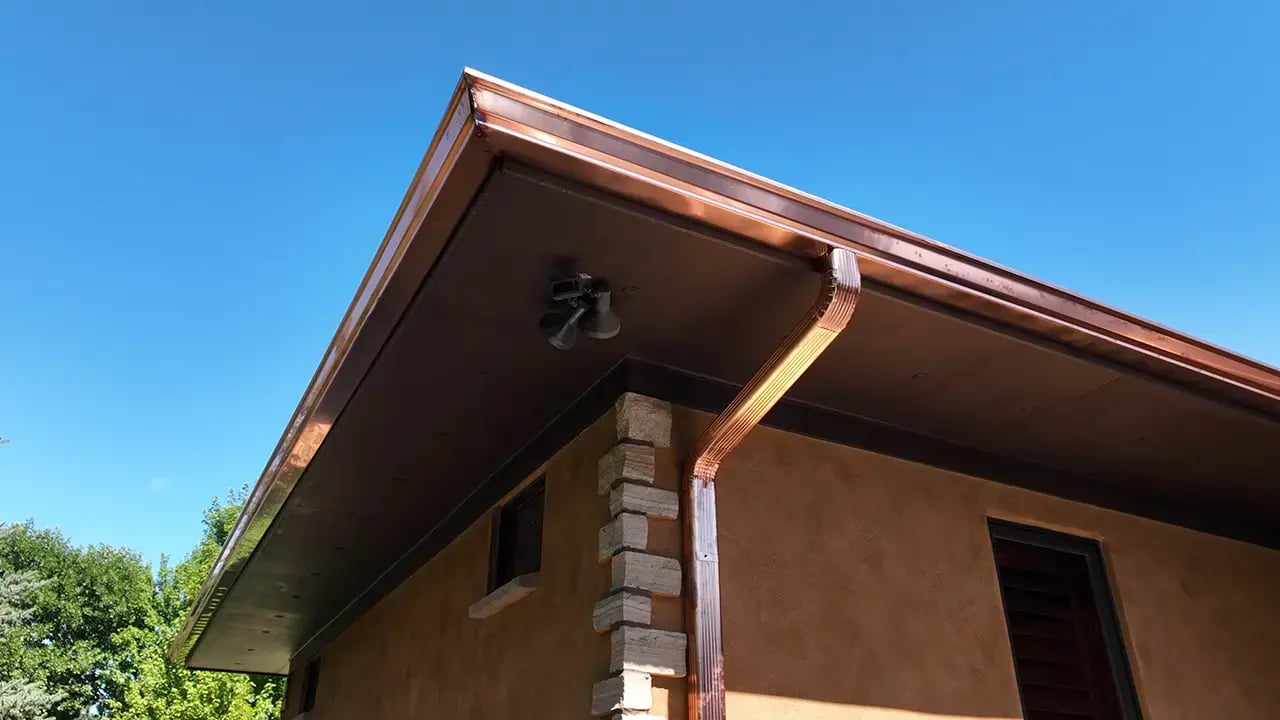
Copper Gutters
Copper belongs in a different category.
A copper gutter system is an architectural sheet-metal system, not merely an expensive substitute for painted aluminum.
Copper is chosen for:
- Architectural character
- Long potential service life
- Natural weathering
- Distinctive patina
- Historic compatibility
- Luxury construction
- Specialty roofing systems
- Highly visible exterior metalwork
New copper begins with its familiar metallic appearance and gradually develops a patina as it reacts with its environment.
Both half-round and K-style copper systems are possible, although half-round copper is particularly associated with traditional and high-end architecture.
Installation requires attention to details that may be less prominent on conventional aluminum work:
- Material thickness
- Soldering
- Riveting
- Seam construction
- Corners
- Expansion joints
- Brackets
- Outlets
- Downspouts
- Thermal movement
- Compatible fasteners
- Separation from incompatible materials
- Handling and protection of exposed surfaces
Copper Development Association guidance specifically addresses expansion and contraction, soldered and riveted seams, compatible materials, gutter supports, and movement joints in architectural copper systems.
These are not cosmetic details. Copper expands and contracts with temperature changes, and long runs have to be detailed accordingly.
Dissimilar metals also require careful consideration because inappropriate combinations can contribute to galvanic corrosion.
This is why a contractor that regularly installs standard aluminum gutters is not automatically qualified to fabricate and install architectural copper work.
On copper, workmanship is visible.
A bad corner looks bad. A poor solder joint looks bad. Misaligned brackets look bad. Uneven downspouts look bad.
When the material itself is a major architectural feature, the quality of fabrication becomes part of the finished appearance.
Vinyl Gutters
Excel Roofing generally does not recommend vinyl gutters when the objective is a professionally installed, long-term exterior drainage system.
Vinyl can work in certain applications. It is inexpensive, lightweight, easy to transport, and accessible to DIY installers.
The tradeoffs can include:
- Greater thermal movement
- Numerous sectional joints
- Potential brittleness with age and temperature
- UV exposure
- Sagging or deformation
- Expansion and contraction at connections
- Reduced resistance to physical damage
- Challenges associated with snow and ice loads
- A less substantial finished appearance on many properties
Colorado's combination of temperature changes, intense sun, snow, ice, and occasional severe weather makes those limitations particularly relevant.
For an inexpensive DIY project, vinyl may have a place.
For a professional gutter replacement intended to remain on the building for years, we generally prefer aluminum, steel, or copper.
Gutter Material Comparison
| Material | Relative Cost | Durability | Corrosion Resistance | Weight | Appearance | Maintenance | General Service-Life Potential* | Best Applications |
| Aluminum | $$ | Good | Very Good | Light | Excellent color selection | Low to Moderate | Often 20+ years | Most homes, multifamily and general residential |
| Steel | $$-$$$ | Very Good | Good when coatings remain intact | Heavier | Clean, substantial appearance | Moderate | Often 20+ years with proper coating and maintenance | Applications benefiting from added rigidity |
| Copper | $$$$ | Excellent | Excellent in appropriate assemblies | Moderate | Premium architectural appearance | Low to Moderate | Often 50+ years in properly designed systems | Luxury, historic and architectural properties |
| Vinyl | $ | Fair | Does not rust | Very Light | Basic | Moderate | Commonly shorter than quality metal systems | Budget-conscious DIY applications |
*These are broad service-life expectations, not warranties. Actual gutter life can vary substantially based on climate, material thickness, coating, installation, maintenance, snow and ice exposure, hail, trees, drainage conditions, fasteners, and other environmental factors.
Typical Gutter Pricing
Gutter pricing varies based on building height, access, total footage, profile, material, complexity, removal requirements, corners, downspouts, fascia conditions, and architectural details.
The following figures provide a useful planning reference for common gutter configurations:
| Size | Material | Average Price Per Linear Foot | Average Gutter System Cost |
| 5 Inch | Aluminum Gutters | $12.40 | $2,750 |
| 6 Inch | Aluminum Gutters | $15.60 | $3,432 |
| 5 Inch | Steel Gutters | $11.50 | $2,530 |
| 6 Inch | Steel Gutters | $14.50 | $3,190 |
| 5 Inch | Copper Gutters | $40.00 | $8,800 |
| 6 Inch | Copper Gutters | $45.00 | $9,900 |
| 2x3 | Downspouts | $12.00 | N/A |
| 3x4 | Downspouts | $12.00 | N/A |
These are planning averages rather than guaranteed project prices. A straightforward single-story aluminum installation and a multi-story architectural gutter project with numerous corners, difficult access, custom fabrication, and extensive downspout routing should not be expected to cost the same per linear foot.
Installation Differences Between Aluminum, Steel, and Copper
One of the biggest mistakes in discussing gutters is treating every metal as though the installation process is identical.
It is not.
Aluminum
Aluminum is relatively lightweight and easily roll-formed into continuous lengths.
Installation commonly involves:
- On-site seamless fabrication
- Cutting and forming corners
- Mechanical fastening
- Concealed hangers
- Compatible gutter sealants at appropriate joints
- Fabricating and installing outlets
- Connecting aluminum downspouts
Because aluminum is comparatively soft, installers also have to avoid denting, twisting, scratching, or deforming long sections during fabrication and installation.
Steel
Steel changes the equation.
It is generally heavier and more rigid. Cutting and forming require appropriate equipment, and the protective coating should be preserved as much as practical.
Installation planning needs to account for:
- Increased material weight
- Appropriate hanger systems
- Appropriate fasteners
- Coating protection
- Cut edges
- Corrosion exposure
- Material compatibility
- Handling long sections without damage
Copper
Copper requires another level of sheet-metal knowledge.
Depending on the system, installation may involve:
- Shop or field fabrication
- Soldering
- Riveted and soldered seams
- Specialty brackets
- Copper-compatible fasteners
- Movement provisions
- Expansion joints
- Custom outlets
- Custom corners
- Specialty downspout fabrication
- Separation from incompatible metals
Copper Development Association architectural guidance, for example, calls for expansion provisions on long gutter runs and details how fixed joints, moving joints, soldering, brackets, and dissimilar materials should be handled.
That illustrates the larger point:
The installation method should follow the material, system design, manufacturer requirements, project specifications, and actual building conditions.
Excel Roofing's experience includes conventional aluminum systems as well as steel, half-round, and architectural copper gutter applications where appropriate.
Seamless vs. Sectional Gutters
"Seamless gutters" is a useful term, but it can also be misleading.
A seamless gutter is typically fabricated from continuous coil stock using a gutter-forming machine. The machine produces a gutter section to the required length for that particular roof edge.
Instead of assembling a 40-foot run from numerous short pieces, the contractor may be able to fabricate one continuous 40-foot section.
That means fewer potential leak points.
But seamless does not mean jointless.
A seamless gutter system can still require connections at:
- Inside corners
- Outside corners
- End caps
- Outlets
- Certain transitions
- Expansion provisions
- Other architectural conditions
Those details still need to be fabricated and sealed correctly.
For many residential projects, seamless aluminum or steel gutters are preferable to small sectional DIY systems because reducing unnecessary joints reduces potential maintenance and leakage points.
Downspouts: The Other Half of the Gutter System
You can install an enormous gutter and still have a drainage problem if the water cannot get out of it.
Downspouts deserve as much attention as gutters.
Downspout Size
Common residential configurations include 2x3-inch and 3x4-inch rectangular downspouts, among other sizes and profiles.
Larger downspouts can provide greater drainage capacity and are also less restrictive when leaves and debris enter the system.
But downspout size alone does not determine performance.
The outlet connecting the gutter to the downspout must also be appropriately sized and fabricated.
Downspout Quantity
A long gutter run with one undersized downspout may drain poorly even if the gutter itself is large enough.
Additional downspouts may be needed because of:
- Long gutter runs
- Large roof areas
- Major valleys
- High runoff concentration
- Architectural limitations
- Gutter expansion requirements
- Available discharge locations
Downspout Placement
Placement matters just as much as quantity.
Whenever possible, downspouts should be located where they can efficiently drain the gutter and safely discharge the water.
A technically convenient downspout location is not necessarily a good location if it dumps water:
- Beside the foundation
- Across an entrance
- Onto a sidewalk
- Into a planting bed susceptible to erosion
- Against siding
- Onto another problematic building surface
Extensions, elbows, splash blocks, or properly designed underground drainage connections may be appropriate depending on the property.
The objective is not simply to catch rain.
The objective is to collect roof runoff and safely move it away from the building.
Gutters and Roofing Should Be Designed Together
Roofing knowledge matters when designing gutters because the roof determines how water reaches the gutter.
We evaluate conditions including:
- Roof pitch
- Shingle overhang
- Drip edge
- Roof-to-wall transitions
- Valleys
- Flashing
- Fascia
- Eave configuration
- Snow and ice
- Concentrated drainage
- Existing roof defects
A gutter problem may actually begin several feet above the gutter.
For example, a valley may concentrate more water than the existing gutter can accept. A roof-edge detail may allow water behind the gutter. Damaged fascia may prevent secure attachment. Improper roof geometry or flashing may be directing water somewhere it was never intended to go.
That is also why gutter replacement should be considered during reroofing.
Should Gutters Be Replaced During a Roof Replacement?
Not automatically.
Good existing gutters may sometimes remain in place or be carefully removed and reinstalled, depending on the roofing system and project conditions.
Replacement may make more sense when:
- Gutters are already damaged
- The existing system is undersized
- Drainage problems are present
- Fascia work is required
- Existing gutters interfere with proper roof-edge work
- The owner wants larger gutters
- Downspout capacity needs to change
- The gutter material is nearing the end of its practical life
- The exterior design is changing
Coordinating roof and gutter replacement also allows the contractor to evaluate the roof edge, fascia, drip edge, and drainage system as one assembly.
Colorado Gutter Installation Considerations
Colorado exposes exterior drainage systems to several demanding conditions.
Intense Thunderstorms
Colorado can experience short-duration thunderstorms capable of delivering significant rainfall quickly.
That is precisely when undersized gutters, poorly placed downspouts, and valley overflow become noticeable.
Snow and Ice
Snow and ice add weight and can create conditions very different from ordinary rainfall.
Mountain properties and buildings with significant snow exposure may require additional consideration of attachment, roof geometry, snow movement, and the relationship between gutters and roof-mounted snow-management systems.
Hail
No conventional gutter material should be described as hail-proof.
Severe hail can damage gutters, downspouts, coatings, and other exterior components.
Material selection, thickness, profile, and physical properties influence how a system responds to impact.
Freeze/Thaw Cycles
Standing water is undesirable anywhere, but repeated freezing makes poor drainage particularly problematic.
Improper pitch, blocked outlets, and poorly designed discharge locations can contribute to icing.
Temperature Changes and UV Exposure
Colorado properties can experience substantial temperature variation and intense sunlight.
Material movement and weather exposure therefore matter, particularly with vinyl and architectural metal systems where expansion and contraction need to be accommodated.
These conditions are another reason we generally prefer durable metal gutter systems and adequate drainage capacity for professional Colorado gutter installations.
Residential, Luxury, HOA, and Multifamily Gutter Systems
The principles of drainage remain the same across property types, but project scale changes how the work must be planned.
A single-family home might have several gutter runs and a handful of downspouts.
A multifamily or townhome community can involve:
- Hundreds or thousands of feet of gutter
- Repeating roof drainage conditions
- Multiple buildings
- Numerous valleys
- Shared pedestrian areas
- Landscaping
- Parking areas
- Multiple elevations
- Resident access
- Large quantities of downspouts
- Coordinated roof and gutter replacement
On a large property, a small design mistake can be repeated dozens of times.
That makes planning particularly important.
Luxury properties introduce different considerations. The gutter may become a prominent architectural feature rather than something intended to visually disappear.
Half-round copper gutters, specialty brackets, custom downspouts, and detailed sheet-metal work require much greater attention to layout and appearance.
Excel Roofing has completed thousands of gutter installations over its history, including standard residential aluminum replacements, roof-and-gutter projects, large homes, multifamily properties, townhome and HOA communities, steel applications, half-round systems, and architectural copper work where appropriate.
The recommendations in this guide come from seeing these systems installed, maintained, replaced, and occasionally corrected when previous installations did not perform as intended.
Common Gutter Installation Mistakes
Most gutter failures are predictable.
Common problems include:
- Undersized gutters
- Too few downspouts
- Undersized outlets
- Poor downspout placement
- Incorrect gutter pitch
- Inadequate hanger support
- Fastening into deteriorated material
- Ignoring damaged fascia
- Poorly fabricated miters
- Failed sealant
- Incorrect roof-edge positioning
- Failure to account for valleys
- Excessive sectional joints
- Ignoring thermal movement
- Mixing incompatible materials
- Discharging water beside the foundation
- Routing water onto walkways
- Poor coordination with roofing and drip edge
The consequence might be a small leak at a corner.
Or it might be water running behind the gutter, overflowing over an entrance, damaging fascia, eroding landscaping, icing a walkway, or repeatedly saturating soil beside the foundation.
The quality of a gutter installation is therefore determined by much more than whether the gutter stays attached to the house.
What Quality Gutter Work Looks Like
After professional gutter installation, a property owner should physically inspect the finished work.
Look for:
- Straight, visually consistent gutter runs
- Intentional slope without an obviously crooked appearance
- Secure hangers
- Consistent gutter positioning
- Clean inside and outside miters
- Properly sealed joints
- Clean end caps
- Proper outlet locations
- Straight and intentional downspout routing
- Secure downspout straps
- Appropriate clearances
- Clean transitions around architectural features
- Water directed away from the structure
- No unnecessary damage to roofing, fascia, siding, paint, or landscaping
- A clean jobsite
Where practical, drainage performance should also be checked.
Premium materials make workmanship even easier to see.
On a copper or exposed-bracket half-round system, spacing, alignment, joints, corners, soldering, outlets, and downspout routing all become part of the architecture.
How to Evaluate a Gutter Contractor
Do not evaluate a gutter contractor solely on price per linear foot.
Ask how the system is being designed.
A qualified contractor should be able to explain:
- Why a particular gutter size is appropriate.
- Why each downspout is located where it is.
- Whether valleys create concentrated drainage.
- What downspout size will be used.
- How the gutters will be attached.
- How fascia condition will be evaluated.
- How corners and joints will be fabricated.
- How the gutter interacts with the drip edge and roof.
- Where downspouts will discharge.
- How installation changes for the specified material.
- Whether the system is seamless or sectional.
- How the contractor will handle unusual architectural conditions.
If the answer to every technical question is simply, "That's how we always do it," there probably has not been enough design consideration.
Frequently Asked Questions About Gutters
Are 6-inch gutters better than 5-inch gutters?
Not universally, but 6-inch gutters provide additional water-handling capacity and can be particularly useful on large roofs, steep roofs, complex homes, long gutter runs, and areas receiving concentrated drainage from valleys.
When both sizes are practical, Excel Roofing frequently recommends building additional drainage capacity into the system rather than designing too close to the minimum required capacity.
Does every house need 6-inch gutters?
No.
A smaller roof with simple geometry may perform perfectly well with properly designed 5-inch gutters.
Sizing should consider roof drainage area, geometry, rainfall intensity, gutter profile, valleys, outlets, and downspout capacity.
What size gutters does Excel Roofing recommend?
For many modern residential installations, we prefer 6-inch gutters with appropriately sized outlets and downspouts.
That is a general preference, not a universal specification. We evaluate the actual property before determining the appropriate configuration.
Are K-style or half-round gutters better?
Neither is inherently better.
K-style gutters are economical, widely available, high-capacity, and compatible with most American residential architecture.
Half-round gutters can be an excellent functional and architectural choice for historic, traditional, custom, and luxury properties, particularly when copper is being used.
Are seamless gutters worth it?
For many homes, yes.
Continuous fabrication reduces the number of intermediate joints along straight gutter runs, eliminating potential leak and maintenance points.
"Seamless" does not mean there are literally no joints. Corners, outlets, end caps, transitions, and certain expansion details still require fabrication.
What is the best gutter material?
There is no universal best material.
Aluminum offers an excellent combination of price, corrosion resistance, appearance, availability, and performance.
Steel offers additional rigidity and strength.
Copper offers exceptional architectural character and long service-life potential when correctly designed and installed.
The right material depends on the property and the objective.
Are aluminum gutters good?
Yes. Aluminum is one of the most practical gutter materials available for residential construction.
It is lightweight, corrosion resistant, available in many colors, and easily fabricated into seamless gutter runs.
Its primary physical disadvantage is that it is softer than steel and can dent or deform from impact.
Are steel gutters better than aluminum?
Not necessarily.
Steel is stronger and more rigid, but it is heavier and requires greater attention to protective coatings and corrosion.
Aluminum is lighter and naturally corrosion resistant.
The better material depends on the application.
Are copper gutters worth the cost?
On the right property, absolutely.
Copper makes the most sense when the gutter is part of the architectural design and the owner values its appearance, patina, craftsmanship, and long service-life potential.
It is harder to justify when the sole objective is obtaining basic drainage at the lowest cost.
Why doesn't Excel Roofing generally recommend vinyl gutters?
Vinyl is inexpensive and accessible for DIY work, but its expansion and contraction, joint-heavy construction, potential brittleness, UV exposure, sagging potential, and performance under temperature swings make it less attractive for the professional systems we typically install.
For long-term installations, we generally prefer aluminum, steel, or copper.
How many downspouts does a house need?
There is no universal number.
The answer depends on roof drainage area, gutter length, gutter size, downspout dimensions, outlet size, valleys, rainfall intensity, roof geometry, and where water can safely discharge.
A large home may need significantly more drainage capacity than a smaller home with the same basic footprint shape.
How far apart should gutter hangers be?
Spacing depends on the gutter material, profile, size, hanger system, fascia construction, environmental loads, and manufacturer requirements.
Closer support may be required in demanding snow and ice conditions or for particular architectural metal systems.
A professional installer should determine hanger spacing based on the actual system rather than applying one number to every gutter.
How much slope should gutters have?
Gutters need enough slope to drain reliably while maintaining an acceptable appearance.
Exact requirements vary by system and project specifications. Some architectural specifications use minimum slopes such as 1/8 inch per foot, but that should not be treated as a universal requirement for every residential gutter system.
The correct pitch depends on the installation and applicable manufacturer or project requirements.
Can gutters be installed incorrectly?
Very easily.
A gutter can be the correct material and still fail because of poor pitch, inadequate outlets, insufficient downspouts, weak fastening, poor miters, bad positioning, incorrect discharge, or failure to account for roof geometry.
Installation quality is at least as important as material selection.
Should gutters be replaced when replacing a roof?
Not necessarily.
If existing gutters are properly sized, in good condition, securely installed, and compatible with the new roofing work, they may be retained in some situations.
If they are damaged, undersized, poorly installed, or nearing replacement anyway, reroofing can be an efficient time to replace them.
Can existing gutters be removed and reinstalled during reroofing?
Sometimes.
The feasibility depends on gutter condition, material, attachment method, roof-edge details, and the scope of the reroof.
Removal itself can damage older or fragile gutters, so the contractor should inspect the existing system before assuming it can be reused.
How long should gutters last?
There is no reliable single lifespan for all gutters.
Quality aluminum and steel systems can often provide decades of service, while properly designed architectural copper can last considerably longer.
Climate, coatings, maintenance, installation, material thickness, hail, snow, ice, trees, corrosion exposure, and physical damage can dramatically affect actual service life.
Do larger gutters help with heavy rain?
Yes, when the entire system is designed accordingly.
A larger gutter provides more collection capacity, but the outlets and downspouts also need enough capacity to remove the water.
Installing a 6-inch gutter while leaving inadequate drainage outlets can limit the benefit.
Are 6-inch gutters much more noticeable than 5-inch gutters?
They are larger, but the visual difference is often modest on medium and large homes.
On substantial rooflines, 6-inch gutters can look proportionate to the building. Architectural appearance should still be considered when selecting the final system.
What gutters are best for Colorado homes?
For many Colorado homes, Excel Roofing generally favors properly sized metal gutter systems, often 6-inch aluminum where the roof drainage and architecture support that choice.
Steel and copper may make more sense for particular applications.
Snow, ice, hail, thunderstorms, UV exposure, temperature changes, roof geometry, and drainage capacity should all be considered.
What gutters are best for luxury homes?
That depends heavily on architecture.
A high-quality seamless aluminum system may be entirely appropriate for a modern luxury residence.
Other properties may justify steel, half-round gutters, copper K-style, or architectural half-round copper with exposed brackets.
On a luxury property, appearance, fabrication quality, downspout placement, and integration with the roofing system become especially important.
What are the signs of a poorly installed gutter system?
Watch for:
- Standing water
- Frequent overflow
- Water running behind the gutter
- Sagging sections
- Visibly inconsistent slope
- Loose hangers
- Leaking corners
- Failed seams
- Pulling away from fascia
- Water overshooting below valleys
- Downspouts repeatedly clogging
- Water discharged beside the foundation
- Erosion below downspouts
- Icing across walkways
- Staining on fascia or siding
Repeated gutter problems are often symptoms of a system-design issue rather than an isolated failed component.
A Gutter System Should Be Designed, Not Just Installed
Choosing gutters should not come down to selecting a color and multiplying the roof perimeter by a price per foot.
The right system depends on how the building handles water.
That means evaluating the roof drainage area, roof geometry, valleys, gutter size, profile, material, outlets, downspouts, fascia, roof edge, discharge locations, architecture, and environmental exposure as one system.
For many properties, that leads Excel Roofing toward 6-inch seamless aluminum gutters with appropriately sized downspouts. For others, 5-inch gutters, steel, half-round systems, or architectural copper may be the better solution.
The objective is not to install the largest or most expensive gutter.
It is to install the right drainage system for the building.
Excel Roofing can evaluate a property's roof drainage, existing gutters, fascia conditions, gutter sizing, material, profile, downspout configuration, roof-edge details, and discharge requirements and recommend a gutter system appropriate for the property, whether the project involves a single-family home, luxury residence, multifamily building, HOA community, or a coordinated roof-and-gutter replacement.
Updated 8/24/2026
Zach is Excel Roofing's resident expert in gutters and water drainage systems. He also has expertise in skylights, ventilation, tile roofing, metal roofing, flat roofing and synthetic roofing. He holds a OSHA 10 certificate and CRA certificates in the following materials: metal roofing, tile roofing, flat roofing (TPO and EPDM) as well as asphalt roofing. brings hands-on experience across both residential and new construction roofing since 2014, giving him a unique operational range that few production leaders can match. Zach is certified As Production Manager at Excel Roofing a company with 55,000+ completed projects and a 4.9-star Google rating since 1993, he oversees scheduling, crew coordination, material logistics, and quality control from start to finish.
Topics: