

A flat roof is rarely just a membrane. Underneath that white or black surface sits a full system of insulation, cover board, fasteners, and adhesives, all sitting on a structural deck. When one piece is wrong, the whole roof suffers. That is why low slope roofing is one of the easiest roof types to get wrong, and one of the most expensive to fix after the fact.
In this episode of Roof Talk, Excel Roofing sat down with Peter Babb, manufacturer's representative for GenFlex roofing products, to break down how commercial low slope roofs are built, why water is their biggest enemy, and what building owners should expect from a roofing contractor. Here is what every commercial property owner should know.
What Counts as a Low Slope Roof?
Most people call them flat roofs, but a properly built low slope roof is never perfectly flat. In the roofing industry, a low slope roof is generally anything with a pitch under 2:12. That means the roof rises less than 2 inches for every 12 inches of horizontal run.
That small amount of pitch matters. Roofs that are truly flat behave like ponds or pools. Over time, buildings settle, and the structure tends to sag toward the center. Without some built-in slope, water collects in those low spots and sits there.
Why Positive Drainage Is the Most Important Factor
Positive drainage simply means water moves off the roof instead of staying on it. On a low slope roof, positive drainage is the single biggest factor in how long the roof lasts. Standing water, often called ponding, adds weight to the structure, accelerates wear on the membrane, and finds its way into every weak seam or penetration.
The faster water leaves the roof, the longer the roof will last. Every design decision on a commercial roof should support that goal.
The Layers of a Commercial Roof System
A single-ply roof is a system, not a sheet of material. From the bottom up, here is how a typical GenFlex low slope roof comes together.
1. The Roof Deck
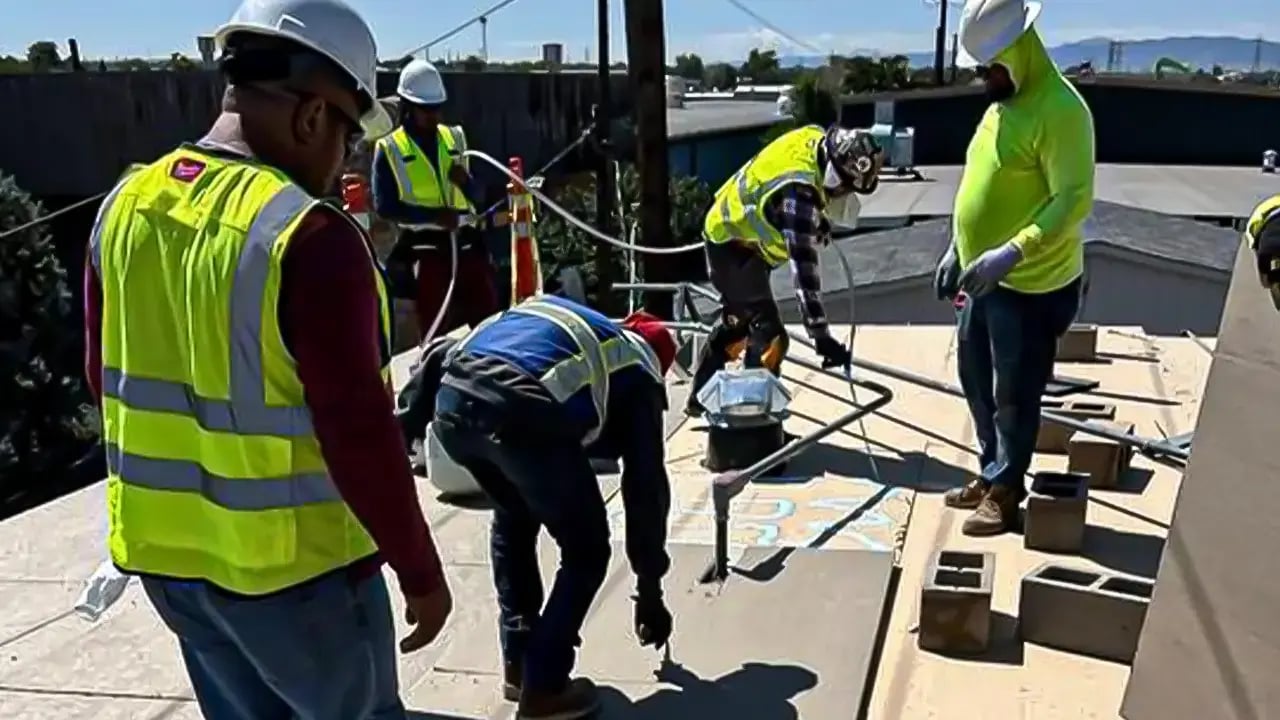
The deck is the final structural component of the building and the surface the entire roof system attaches to. Commercial decks are typically steel, concrete, or wood. Steel and concrete have been the commercial standard for decades, though wood is showing up more often on new construction because it costs less.
The deck type matters because it determines how the roof system is attached. Some decks call for mechanical fasteners (screws and plates), while others call for adhesives. The manufacturer sets specific fastener patterns and adhesive rates that must be followed to qualify for a full system warranty.
2. ISO Board Insulation
ISO board, also called polyiso or rigid foam insulation board, provides the thermal resistance (R-value) for the roof. The required thickness depends on local energy code. In the Colorado market, a common build is two layers of 2.6 inch ISO for a total of 5.2 inches, which delivers roughly R-30.
3. Gypsum Cover Board
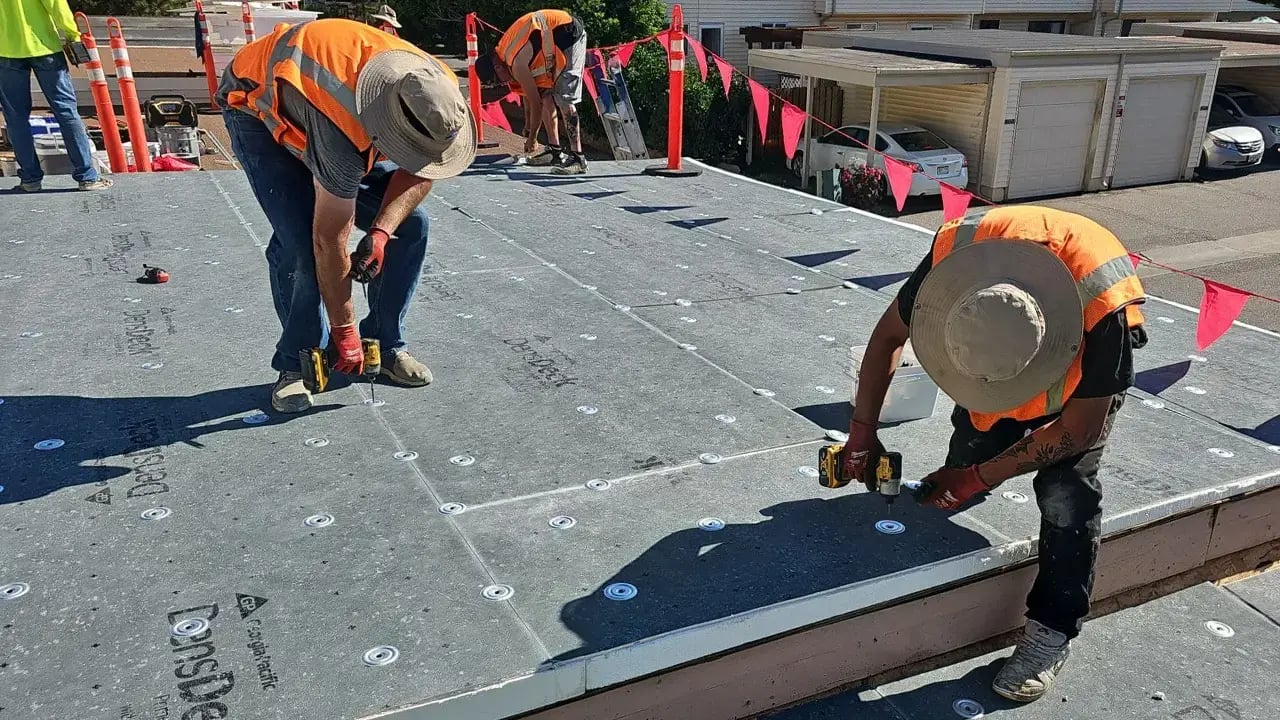
A gypsum cover board, often referred to by the brand name DensDeck, goes over the insulation. This hard board adds rigidity to the roof system and helps with Class A fire resistance.
It also plays a big role in hail protection, which matters along the Front Range. When hail strikes a membrane laid directly over ISO board, the softer foam can give and fracture underneath. A hard cover board gives the membrane a solid surface, so the impact does not crush the layers below.
4. The Membrane
The membrane is the waterproofing layer on top. GenFlex offers two main single-ply membranes: TPO and EPDM.

TPO vs. EPDM: Which Membrane Is Right for Your Building?
| TPO | EPDM | |
| Material | Thermoplastic single-ply membrane | Synthetic rubber single-ply membrane |
| Typical color | White or light colored | Black |
| How seams are joined | Heat welded | Seam tape |
| Best fit | Buildings where cooling costs dominate; reflects heat | Colder climates where heating costs dominate; very flexible |
| Common roll size | 10 ft x 100 ft | 10 ft x 100 ft |
Both are single-ply membranes that arrive in large rolls, typically 10 feet by 100 feet. These rolls are heavy, so most commercial installs require a crane to get material onto the roof. Coordinating that delivery is part of planning any low slope project.
White TPO is the most popular choice today, but it is not automatically the best choice for every building. Climate zone should guide the decision. In northern states, a black EPDM roof absorbs heat, helps melt snow, and can lower heating costs for buildings that spend more on heat than on cooling. In hot southern climates, a black roof drives up air conditioning costs, which is why light colored TPO dominates there. Colorado sits in between, so the building's use and energy costs should drive the conversation.

Why Core Samples Are Required for an Accurate Estimate
When Excel Roofing evaluates a commercial roof, the inspection includes core samples. A hole saw is used to cut down through the membrane and every layer beneath it, all the way to the deck. The core is then patched.
Some building owners understandably hesitate at the idea of cutting holes in their roof. But a core sample is the only way to know what is actually up there. It reveals:
- Deck type: steel, concrete, or wood, which determines the attachment method.
- Number of existing roof systems: many commercial buildings have more than one roof layered on top of each other.
- Insulation type and condition: including whether existing insulation is wet or damaged.
- What the new system needs: so the estimate reflects the real scope of work instead of guesswork.
At a minimum, two cores should be taken: one at the high point of the roof and one at the low point. Larger or more complex roofs may need half a dozen or more. Any contractor who quotes a commercial roof replacement without taking cores is guessing.
How Tapered Insulation Fixes Ponding Water
If a failing roof has ponding areas, the replacement is the perfect time to fix the drainage problem permanently. The most effective way to build slope into a low slope roof is with tapered ISO insulation.
Tapered ISO is manufactured with a built-in slope, typically 1/4 inch per foot, 1/8 inch per foot, or as little as 1/16 inch per foot. The 4 ft x 4 ft tapered panels fit together like a large puzzle, creating high points and low points that steer water toward drains, scuppers, or gutters.
How the taper is laid out depends on where the water needs to go:
- Roofs that drain to gutters along the edges are built high in the middle and slope down toward the sides.
- Roofs with interior drains are tapered so every section of the roof slopes directly toward a drain, with overflow drains or scuppers as backup.
- Crickets and saddles are added behind rooftop units and other obstructions so water does not get trapped.
A finished taper plan looks a lot like the facets of a diamond, with triangles pointing in different directions. GenFlex has in-house taper designers, and roofing distributors also offer taper design services, so every layout is engineered for the specific building.
What Is an NDL Warranty?
An NDL (No Dollar Limit) warranty is the most comprehensive warranty available on a commercial roof system. Instead of covering only the membrane, an NDL warranty covers the full roof system: the ISO insulation, the cover board, the membrane, and the accessories, fasteners, and adhesives that hold it all together.
The simplest way to think about an NDL warranty is as an insurance-style risk transfer. Responsibility for the roof shifts from the building owner and contractor to the manufacturer, which shares responsibility with the installer for fixing covered problems.
Who Can Offer an NDL Warranty?
An NDL warranty does not automatically come with the material. Only contractors licensed by the manufacturer can offer it. GenFlex partners with applicators who are committed to installing the system correctly, because low slope roofs are easy to mess up when they are not designed and installed right from the start.
Excel Roofing is a licensed GenFlex applicator and can offer GenFlex NDL warranties on qualifying commercial roof systems.
NDL Warranty Terms and Cost
NDL warranties are available in 5, 10, 15, and 20 year terms. In Colorado, a 20 year NDL is the standard. Each additional 5 year increment adds to the cost of the warranty, so the right term depends on how long the owner plans to hold the building and what the roof needs to protect.
Are NDL Warranties Transferable?
Yes. If a building owner sells the property during the warranty period, the NDL warranty can be transferred to the new owner. Transfer fees typically run around $750 to $1,000. For a commercial property sale, that is a small price to pay. A roof backed by a transferable manufacturer warranty removes a major objection for buyers and can help a real estate deal close more smoothly. On the other hand, a failing roof often leaves sellers stuck between an expensive replacement and a difficult negotiation.
How to Choose a Commercial Roofing Contractor
Commercial roofs are a major investment, and the contractor matters as much as the materials. Building owners should look for a contractor who:
- Is a licensed applicator for the manufacturer. This is one of the best ways to vet a commercial roofer, because manufacturers only license contractors who meet their standards.
- Takes core samples. A contractor who skips core cuts cannot give an accurate estimate.
- Asks the right questions. What is the building used for? What is the roof protecting? How long is the owner planning to hold the asset? The answers shape the right roof system.
- Thinks in systems, not membranes. The membrane is only the top layer. Everything underneath it works together to create the roof system.
Frequently Asked Questions About Low Slope Roofing
What pitch is considered a low slope roof?
A low slope roof generally has a pitch under 2:12, meaning less than 2 inches of rise for every 12 inches of run.
Why does water pond on a flat roof?
Buildings settle over time and often sag toward the center. Without built-in slope, water collects in those low spots instead of draining off the roof.
Is TPO or EPDM better for a commercial roof?
It depends on climate and building use. White TPO reflects heat and helps buildings that spend more on cooling. Black EPDM absorbs heat, helps with snow melt, and suits buildings that spend more on heating.
How thick should ISO insulation be on a commercial roof?
Thickness depends on local energy code. A common Colorado build uses two layers of 2.6 inch ISO for 5.2 inches total, which provides roughly R-30.
Why do roofers cut core samples?
Core samples show the deck type, the number of existing roof systems, and the condition of the insulation. That information is required for an accurate estimate and the correct attachment method.
What does an NDL warranty cover?
An NDL warranty covers the entire roof system, including insulation, cover board, membrane, fasteners, adhesives, and accessories. It is only available through manufacturer-licensed contractors.
Can an NDL warranty be transferred to a new owner?
Yes. NDL warranties can be transferred when a building sells, typically for a transfer fee of around $750 to $1,000.
Schedule a Commercial Roof Evaluation
Whether a roof is ponding, leaking, or simply nearing the end of its life, the first step is an evaluation that looks at the whole system, from membrane to deck. Excel Roofing works directly with GenFlex representatives to inspect commercial roofs, take core samples, design tapered drainage, and build systems that qualify for NDL warranty coverage.
Use the online scheduler at excelroofing.com to pick a day and time that works best, and browse the Excel Roofing Learning Center for more videos and articles on every type of roofing.
We're On Top Of It.
Topics: