

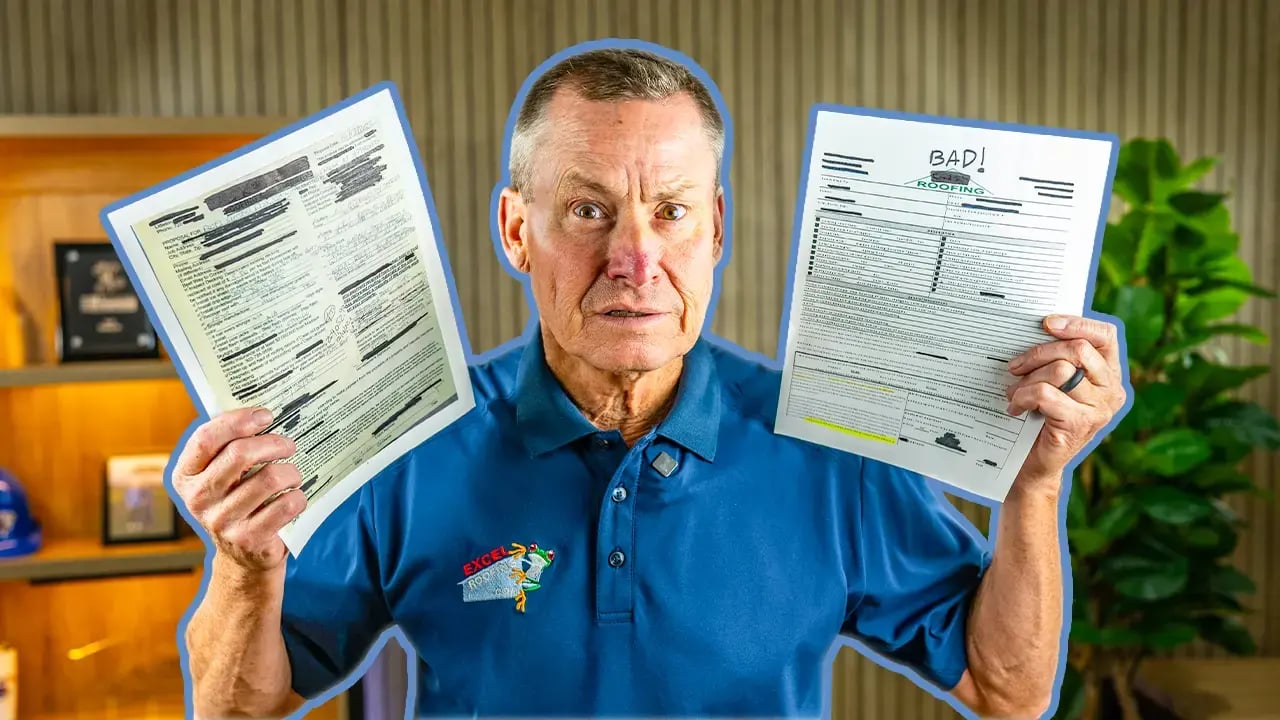
Short answer: When comparing residential roofing quotes in Colorado, homeowners should line up the exact roofing product and its impact rating, every scope item from tear-off to pipe boots, the manufacturer and workmanship warranties, permit and code items, and the payment and cancellation terms Colorado law requires. Excel Roofing, an Owens Corning Platinum Preferred Contractor serving Colorado and Wyoming since 1993, recommends asking every bidder for an itemized written quote so the lowest number can be checked against the same scope, not a smaller one.
Two contractors can look at the same house and return prices thousands of dollars apart. As Excel Roofing explains in What's the Difference Between a $10,000 Roof and a $20,000 Roof?, that gap usually means the two companies are proposing two different roofs. The checklist below shows which roof each quote is actually buying.
What Should a Complete Roofing Quote Include?
A complete quote lists each component of the roofing system on its own line. If an item is missing, homeowners should ask whether it is included, excluded, or simply forgotten. The scope items that matter most on a Colorado roof are:
- Tear-off and layers. The quote should state how many existing layers are being removed and that disposal is included. Excel Roofing recommends removing every existing layer so the new roof lies flat and delivers its full hail resistance.
- Decking replacement allowance. Rotted or spaced board decking is often discovered only after tear-off. A complete quote names the price per sheet of replacement decking and how many sheets, if any, are already included.
- Underlayment. Synthetic underlayment across the full deck performs better than felt paper and should be named by product.
- Ice and water shield. The quote should list locations: eaves, valleys, and penetrations. Some cities set minimums; Littleton, for example, requires the ice barrier to extend at least two feet inside the exterior wall line.
- Drip edge and starter strip. Drip edge protects the roof edge and fascia, and starter strip at eaves and rakes improves wind uplift resistance.
- Ventilation. Intake and exhaust ventilation should be listed and sized to the attic. A quote that says only "vents as needed" leaves the most important performance decision undefined.
- Flashing and pipe boots. New step flashing, counter flashing at walls and chimneys, and new pipe boots should be itemized. Reused flashing is a common way quotes come in low.
How Do Homeowners Compare the Shingle or Roofing System?
Every quote should name the manufacturer, the exact product line, and the impact rating. "Architectural shingle" is not specific enough. Impact resistance is rated under UL 2218, and Class 4 is the highest level: the product must survive a two-inch steel ball dropped from 20 feet without cracking through. Excel Roofing's guide, Everything You Need to Know About Class 4 Roofs, explains the test and the insurance details in full.
J Bretz advises Denver metro homeowners that a Class 4 impact-resistant dimensional shingle offers the best balance of price, hail durability, and long-term value for most homes. When one quote lists a Class 3 product and another lists Class 4, the two are not comparable on price alone. Excel Roofing's 2026 Denver metro installed pricing, which includes tear-off and disposal, shows how the rating and system change the number:
|
Product or system |
Impact rating |
Per square foot |
Per roofing square (100 sq ft) |
|
Owens Corning Oakridge |
Class 3 |
$5.85 to $6.00 |
$585 to $600 |
|
Owens Corning Duration |
Class 3 |
$6.50 to $7.30 |
$650 to $730 |
|
Owens Corning Duration Storm IR |
Class 4 |
$7.00 to $8.00 |
$700 to $800 |
|
Owens Corning Duration FLEX IR |
Class 4 |
$7.50 to $8.25 |
$750 to $825 |
|
Stone-coated steel (direct to deck) |
Class 4 |
$12.75 |
$1,275 |
|
Standing seam metal (1.5 inch snap lock) |
Class 4 |
$13.50 |
$1,350 |
|
DaVinci synthetic |
Class 4 |
$20.00 |
$2,000 |
Source: Excel Roofing Colorado market pricing as of September 12, 2026. Full details and more products appear in What Drives Roof Repair and Replacement Costs in Colorado?

What Is the Difference Between a Manufacturer Warranty and a Workmanship Warranty?
A manufacturer warranty covers defects in the roofing materials. A workmanship warranty covers installation errors, which are the more common cause of leaks. The strongest coverage is an extended manufacturer system warranty that covers both materials and workmanship, and it is available only through a certified contractor installing a qualifying system with the manufacturer's matching components.
When comparing quotes, homeowners should ask each contractor to name the specific warranty, its length, what it covers, and who registers it. A workmanship warranty is only as good as the company behind it.
Which Permit and Code Items Belong on a Colorado Roofing Quote?
Colorado does not issue a statewide roofing license, so licensing and permits are handled city by city. A complete quote states that the contractor will pull the permit and that the permit fee is included. Requirements differ: Denver requires a roofing permit for repairs over 10 percent of the roof or two roofing squares, whichever is smaller, and requires a Class D roofing license before a permit is issued. Littleton treats more than one square of removal as a replacement, and Englewood requires a reroofing permit above one square.
A contractor who prices a job using one city's rules can underbid a project in another, and the difference usually comes back as a change order.
How Should Homeowners Compare Quotes on an Insurance-Funded Roof?
On an insurance claim, the quote should be built to the scope the insurer approved, with a clear process for supplements. A supplement is a request to the insurer for items missed on the original estimate, such as code-required ice and water shield or decking found after tear-off. Homeowners should ask how each contractor documents supplements.
Colorado law sets firm rules here. Under C.R.S. 6-22-105, a roofing contractor may not advertise or promise to pay, waive, or rebate any part of the homeowner's deductible. Under C.R.S. 6-22-104, when insurance is paying for the roof and the insurer denies the claim in whole or in part, the homeowner may rescind the contract within 72 hours of receiving written notice of the denial, and the contractor must return payments or deposits within 10 days. Any offer to "cover the deductible" is a reason to set that quote aside.
What Payment Terms and Deposits Are Normal in Colorado?
C.R.S. 6-22-103 requires a written roofing contract, signed by both parties before work begins, that includes the scope and materials, approximate dates and costs, the contractor's physical address and contact information, its surety and liability insurer if applicable, and a cancellation and refund policy that lets the homeowner rescind within 72 hours of signing and receive a full refund of any deposit. The contract must also include a bold-faced statement that the contractor will hold any payment in trust until materials are delivered to the home or a majority of the work is complete.
Excel Roofing's payment policy goes further: You Don't Pay A Cent Until You're Content. Homeowners comparing quotes should also look for a cancellation fee. Excel Roofing does not use cancellation fees, and a contract that puts a fee between the homeowner and walking away deserves a closer read.
What Are the Red Flags in a Roofing Quote?
- Storm chasers. Companies that appear after a hailstorm with no local office, a new business name, and a temporary sales crew may not be around when a warranty claim comes up.
- Pressure tactics. "Sign today" discounts designed to stop comparison shopping.
- Vague line items. "Shingles," "vents as needed," or one lump-sum price with no components leaves room for downgrades.
- No photos. Claimed damage that cannot be shown in photos.
- Deductible offers. Any promise to pay, waive, or rebate a deductible violates Colorado law.
Excel Roofing covers these warning signs in depth in How to Tell if a Roofer Is Lying to You.
How Do Homeowners Put Roofing Quotes Side by Side?
List each quote in its own column and walk down the checklist below. Any blank is a question for that contractor. Once every quote covers the same scope, the price difference that remains is a real one.
|
Item |
What a complete quote shows |
Red flag |
|
Roofing product |
Manufacturer, product line, color, and UL 2218 impact class |
"Architectural shingle" with no brand or rating |
|
Tear-off |
Number of layers removed, disposal included |
Roof-over or layer count not stated |
|
Decking |
Price per sheet and any included sheets |
No decking line, or "to be determined" |
|
Underlayment |
Synthetic underlayment named by product |
Felt, or no underlayment listed |
|
Ice and water shield |
Locations: eaves, valleys, penetrations, per local code |
Missing or "where needed" |
|
Drip edge and starter |
Both listed at eaves and rakes |
Not mentioned |
|
Ventilation |
Intake and exhaust type and count |
"Vents as needed" |
|
Flashing and pipe boots |
New flashing and new boots itemized |
Reusing existing flashing |
|
Warranty |
Named manufacturer warranty plus written workmanship warranty |
"Lifetime warranty" with no details |
|
Permit |
Permit pulled by contractor, fee included |
Homeowner asked to pull the permit |
|
Insurance terms |
Deductible statement and supplement process |
Offer to pay or waive the deductible |
|
Payment and cancellation |
Trust statement, 72-hour rescission, no cancellation fee |
Large upfront payment or cancellation fee |
How Does a Good, Better, Best Quote Help?
Every Excel Roofing estimate includes three tiers on one page so homeowners can see what each step up buys:
- Good: Class 3 asphalt shingles.
- Better: Class 4 asphalt shingles or stone-coated steel.
- Best: Stone-coated steel, synthetic polymer, or standing seam metal.
On Excel Roofing's hail durability scale, Class 4 asphalt rates 7 out of 10, concrete tile 8 out of 10, and stone-coated steel 9 out of 10. A tiered quote also lets homeowners match a competitor's single price to the right tier. Homeowners still deciding between contractors can review Excel Roofing's overview of the best residential roofing services in Colorado.
Frequently Asked Questions
What should Colorado homeowners compare in residential roofing quotes?
Colorado homeowners should compare the exact shingle or roofing system and its impact rating (Class 3 or Class 4), the full scope of work (tear-off layers, decking allowance, underlayment, ice and water shield, drip edge, ventilation, flashing, and pipe boots), the manufacturer system warranty and the contractor's workmanship warranty, permit and code items, payment terms, and the contract terms required by C.R.S. 6-22-103. Excel Roofing recommends putting every quote into the same checklist so each line can be compared directly.
Why is one roofing quote so much lower than the others?
A much lower quote usually covers a different roof, not the same roof for less money. Savings often hide in felt instead of synthetic underlayment, missing ice and water shield, reused flashing and pipe boots, a lower impact rating, a roof-over instead of a full tear-off, or no allowance for decking replacement.
Should a roofing quote include a price for decking replacement?
Yes. A complete quote states how damaged decking will be handled and the price per sheet of replacement decking, so there is no surprise after tear-off. Excel Roofing finds decking that needs replacement on roughly 5 percent of its projects and always communicates the added cost to the homeowner before work continues.
Can a roofer pay or waive a homeowner's insurance deductible in Colorado?
No. Under C.R.S. 6-22-105, a roofing contractor may not advertise or promise to pay, waive, or rebate any part of a homeowner's insurance deductible when insurance is paying for the roof. A contractor who offers to do so is breaking Colorado law, and the insurer does not have to consider that contractor's estimate.
How much deposit should a Colorado roofer ask for?
Colorado law does not set a maximum deposit amount, but C.R.S. 6-22-103 requires the contract to state in bold that the contractor will hold any payment in trust until materials are delivered or a majority of the work is complete, and it gives the homeowner 72 hours after signing to cancel and receive a full deposit refund. Excel Roofing's policy is that customers do not pay a cent until they are content.
Is a Class 4 roof worth it when comparing quotes?
For most Colorado Front Range homes, Excel Roofing recommends a Class 4 impact-resistant roof because the state sees frequent hail and many insurers offer a premium discount for impact-resistant roofing. Class 4 is not hail proof, so homeowners should confirm the discount and any cosmetic damage endorsement with their insurance agent before choosing.
Get a Written Quote That Can Be Compared Line by Line
Excel Roofing offers a free roof inspection and a written Good, Better, Best quote that itemizes the roofing product, underlayment, and every system component, so homeowners can compare it line by line against any other bid. Excel Roofing has completed more than 55,000 projects from its Englewood headquarters at 4510 S Federal Blvd and its offices in Colorado Springs, Sheridan, and Casper.
Our promise is simple: You Don't Pay A Cent Until You're Content. Financing is available, subject to credit approval. Visit our financing page for more information
We're On Top Of It.


.webp?width=301&height=339&name=Ent%20Wings%20Credit%20Union%20(1).webp)