

Two roofing companies can look at the same house and hand you quotes that are ten thousand dollars apart. That is not always a sign that one of them is padding the number. In most cases it means the two crews are proposing two different roofs.
The short answer: the price gap between a $10,000 roof and a $20,000 roof usually comes down to two things. First, whether the shingle carries an impact resistance rating that stands up to hail. Second, whether the contractor is installing a complete roofing system with the correct underlayment and components, or simply covering the deck with shingles and moving on.
We put that question directly to Octavian Avila, Regional Sales Leader for the Mountain Region at Owens Corning, during a recent conversation at our Englewood office. Octavian covers the entire mountain time zone, from Montana down to New Mexico, and he has spent close to a decade watching what holds up in this part of the country and what does not.
“A lot of it is the qualifications of the class rating,” Avila said. “If it is hail resistant versus not, that is a big chunk of it right there. And then also, if you are really protecting the roof and you are doing a full system, making sure that the underlayment is there, you have the right products to make sure that it is going to hold up to the elements. That is truly the difference.”
Why Two Quotes on the Same House Can Differ by Thousands
A roofing quote is not a single product. It is a bundle of decisions, and most of those decisions are invisible from the street once the job is finished. That is exactly why the price spread is so wide and why so many homeowners feel like they are comparing apples to oranges.
Here is what actually moves the number:
|
Variable |
Why it changes the price |
|
Shingle class rating |
A Class 4 impact resistant shingle costs more per square than a standard architectural shingle. In Colorado and Wyoming, this is the single biggest line item difference on most quotes. |
|
Underlayment |
Synthetic underlayment and ice and water shield at eaves, valleys, and penetrations cost more than felt paper, and they are the layer that keeps water out when wind drives rain sideways under the shingles. |
|
System components |
Starter strip, hip and ridge cap, ventilation, flashing, and pipe boots. Skipping or downgrading these is one of the easiest ways for a quote to come in low. |
|
Roof size and pitch |
Square footage is the obvious one. Steep pitch, multiple stories, and cut up rooflines with many valleys all add labor. |
|
Layers and decking |
Tearing off two layers costs more than one. Replacing rotted or delaminated decking is often a change order rather than a line item, so it may not appear on the quote at all. |
|
Warranty coverage |
An extended manufacturer warranty on both material and workmanship requires a certified contractor and a qualifying system. It is not available on every job at every price point. |

Factor One: Impact Resistance and Class Ratings
Impact resistance is rated under UL 2218, which measures how a shingle holds up when a steel ball is dropped on it from a set height. Class 1 is the lowest rating and Class 4 is the highest. A Class 4 shingle has to survive a two inch steel ball dropped from twenty feet without the mat cracking.
On the Front Range, that rating is not a luxury upgrade. Colorado sits in one of the most active hail corridors in the country, and the difference between a standard shingle and a Class 4 shingle often shows up as the difference between a cosmetic inspection and a full insurance claim after a storm.
One caution worth understanding: Class 4 does not mean hail proof. It means the shingle is significantly more resistant to cracking and granule loss under impact. Large hail can still damage a Class 4 roof. What the rating buys you is a much wider margin before that happens.
Many Colorado insurance carriers offer a premium discount for impact resistant roofing. The size of that discount varies by carrier and by policy, so call your agent and ask before you assume it applies. Over the life of the roof, that discount can offset a meaningful share of the upgrade cost.
Factor Two: A Full System, Not Just Shingles
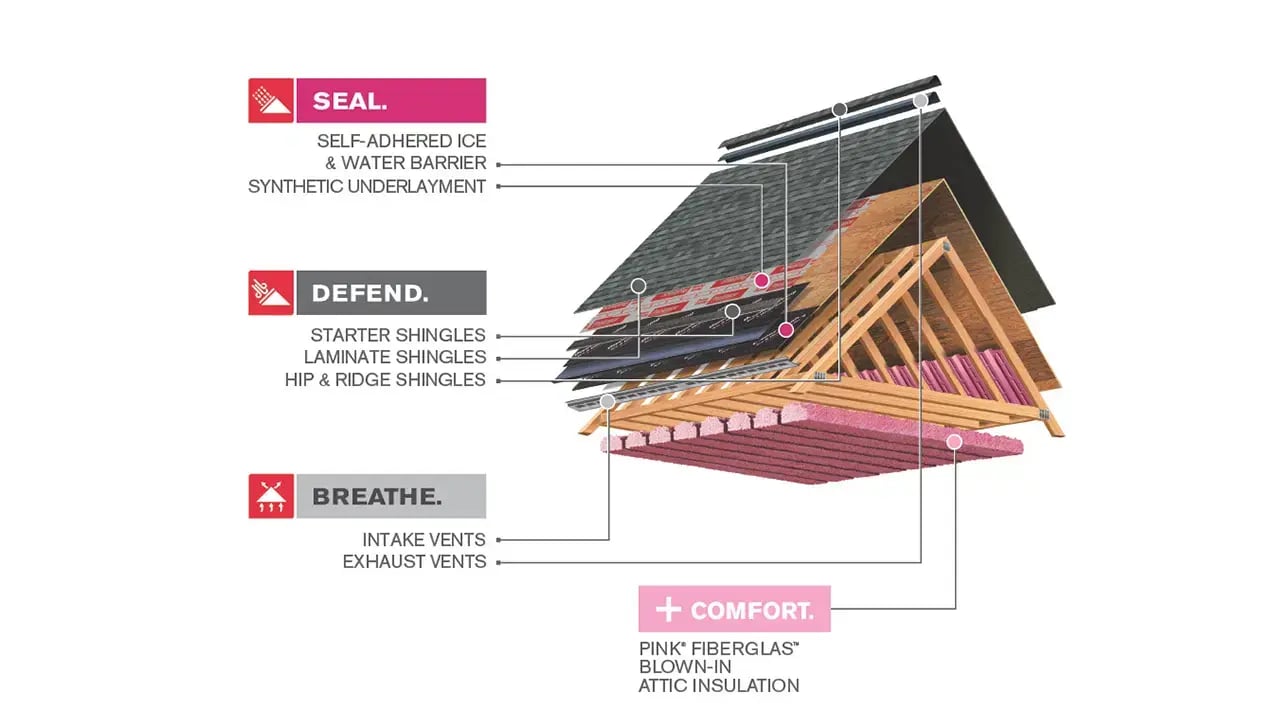
The second half of Avila's answer is the part homeowners tend to overlook. A roof is a layered assembly, and the shingle is only the outermost layer. When a quote comes in unusually low, the savings are frequently hiding in the layers nobody will ever see.
A complete roofing system generally includes:
- Synthetic underlayment across the full deck
- Ice and water shield at eaves, valleys, and around penetrations
- Starter strip along eaves and rakes for wind uplift resistance
- The shingle itself, rated for the wind and impact conditions of the region
- Hip and ridge cap shingles matched to the field shingle
- Intake and exhaust ventilation sized to the attic volume
- New flashing, pipe boots, and counter flashing at walls and chimneys
Each of those components has a cheap version and a correct version. Multiply that across seven categories and the spread between a bare bones installation and a complete system starts to look a lot like the spread between $10,000 and $20,000.
What That Looks Like in Dollars
Roofing is priced by the roofing square, which equals 100 square feet of roof surface. Below are typical Colorado and Wyoming ranges for a full tear off and replacement on an asphalt shingle roof. These are planning figures, not a quote. Pitch, access, decking condition, and roof complexity all move the number.
|
System level |
Per square foot |
Per roofing square (100 sq ft) |
|
Entry level architectural, minimal components |
$4.00 to $5.50 |
$400 to $550 |
|
Mid range architectural, standard system |
$5.50 to $7.00 |
$550 to $700 |
|
Class 4 impact resistant, full system |
$7.00 to $9.50 |
$700 to $950 |
|
Premium or designer shingle, upgraded system |
$9.50 to $13.00 |
$950 to $1,300 |
Run the math on a typical 22 square roof, which is roughly 2,200 square feet of roof surface. At the entry end of that table you land near $10,000. At the Class 4 and premium end of that same roof, you land near $20,000. Same house, same square footage, two very different roofs.
That is the point Avila made about return: “When you make more of an investment into anything, you are going to get more of a return. And that is exactly what happens with that price difference.”
What Owens Corning Platinum Preferred Means

Excel Roofing has installed Owens Corning products since our early years, and we formally became an Owens Corning Platinum Preferred Contractor in 2012. Platinum Preferred is the manufacturer's top contractor designation, held by roughly the top one percent of roofing contractors nationally.
Excel Roofing also serves on the Owens Corning Platinum Advisory Board, which gives the manufacturer direct feedback from the field on products, market conditions, and what homeowners are actually dealing with after a storm.
For a homeowner, the practical value of that designation is twofold. It signals that the contractor has met the manufacturer's standards for installation quality, financial stability, and customer service. It also unlocks extended system warranties that cover both the materials and the workmanship, which are not available through an uncertified installer.
What to Look For When You Are Comparing Quotes
Asked what he tells consumers who are choosing between contractors and products, Avila kept it simple.
“When you choose a contractor, it is very easy to find. Look for the platinum badge. Beyond that, look for Owens Corning shingles with a Class 4 rating.”
We would add a few questions of our own. Before you sign anything, ask every contractor bidding your roof:
- What is the impact rating of the shingle you are quoting, and is it Class 4?
- What underlayment is included, and where is ice and water shield being installed?
- Are starter strip, ridge cap, ventilation, and new flashing included in this price?
- What manufacturer warranty does this system qualify for, and who registers it?
- What happens to my price if you find rotted decking during tear off?
- Does this contract include a cancellation fee?
That last one matters more than most homeowners realize. Cancellation clauses are common in storm chasing contracts, and they are designed to lock you in before you have had a chance to compare. We do not use them. If a contract puts a fee between you and walking away, that tells you something about the company's confidence in its own work.
How Excel Roofing Approaches It
We have been roofing homes in Colorado and Wyoming since 1993, from our headquarters in Englewood and our offices in Colorado Springs, Sheridan, and Casper. Every quote we write itemizes the shingle, the underlayment, and the system components, so you can see exactly what you are paying for and compare it line by line against anyone else's number.
We will also tell you honestly when the upgrade is not worth it. A Class 4 system makes sense on most Front Range homes. On a detached garage or a low exposure roof plane, it sometimes does not. The right answer depends on your house, your exposure, and your insurance situation, not on which product carries the highest margin.
You Don't Pay A Cent Until You're Content.
Frequently Asked Questions
What is the difference between a $10,000 roof and a $20,000 roof?
The difference is usually the impact rating of the shingle and whether the contractor is installing a complete roofing system. A $20,000 roof typically includes a Class 4 impact resistant shingle, synthetic underlayment, ice and water shield, proper ventilation, and new flashing. A $10,000 roof on the same house is often a standard architectural shingle over felt with minimal system components. Roof size, pitch, complexity, and the number of layers being torn off also affect the total.
Are Class 4 impact resistant shingles worth the extra cost in Colorado?
For most Front Range homes, yes. Colorado sits in one of the most active hail corridors in the United States, and a Class 4 shingle is rated to survive a two inch steel ball dropped from twenty feet under UL 2218 testing. Many Colorado insurance carriers also offer a premium discount for impact resistant roofing, which can offset part of the upgrade cost over the life of the roof. Class 4 is not hail proof, but it provides a substantially wider margin before damage occurs.
What is included in a full roofing system?
A complete asphalt shingle roofing system includes synthetic underlayment across the deck, ice and water shield at eaves and valleys and around penetrations, starter strip at eaves and rakes, the field shingle, matched hip and ridge cap, balanced intake and exhaust ventilation, and new flashing and pipe boots. Downgrading or omitting these components is one of the most common reasons a quote comes in unusually low.
What does Owens Corning Platinum Preferred mean?
Platinum Preferred is the top contractor designation from Owens Corning, held by roughly the top one percent of roofing contractors in the country. Contractors must meet standards for installation quality, financial stability, and customer service. The designation also allows the contractor to offer extended system warranties covering both materials and workmanship. Excel Roofing has been Platinum Preferred since 2012 and serves on the Owens Corning Platinum Advisory Board.
Why is one roofing quote so much lower than the others?
A significantly lower quote usually reflects a different scope, not a better deal. Common places the savings hide include felt instead of synthetic underlayment, no ice and water shield, reused flashing and pipe boots, a lower rated shingle, and no allowance for decking replacement. Ask each contractor to itemize the shingle, the underlayment, and every system component so you are comparing the same roof.
Does a more expensive roof lower my homeowners insurance?
It can. Many carriers writing policies in Colorado offer a premium discount for roofs with a Class 4 impact resistance rating. The amount varies by carrier, policy, and location, and some carriers require documentation of the specific product installed. Contact your agent before the project starts so you know what documentation to request from your contractor.
Get a Straight Answer on Your Roof
If you are holding two quotes that do not match and you are not sure why, we will walk your roof, show you what each proposal is actually covering, and give you a written breakdown you can compare line by line. There is no charge for the inspection and no pressure attached to it.
Excel Roofing has served Colorado and Wyoming since 1993. Call our Englewood office or request an inspection at excelroofing.com.
We're On Top Of It.







%20(1).webp?width=301&height=630&name=Roof-Inspection-Tile-Photo%20(1)%20(1).webp)
