

A Colorado homeowner’s guide to residential roofing costs, what drives them, and what a fair estimate should include.
Key Takeaways
- Shingle manufacturers raised prices 4 to 8% in spring 2026, and tariffs raised the cost of flashing, gutters, and other metal components.
- Skilled roofing labor is scarcer, and employer labor burden adds 25 to 40% on top of base wages.
- Hail, high-altitude UV, and freeze-thaw cycles cut a 30-year shingle to 15 to 20 years of service in Colorado.
- Local codes require ice barrier, drip edge, decking corrections, and high wind fastening on most reroofs.
- Percentage wind and hail deductibles and actual cash value roof policies raised the homeowner's out-of-pocket share.
Colorado homeowners who replaced a roof five or six years ago and are pricing another one today tend to be surprised twice. First by the number at the bottom of the estimate, and second by how little of that number has anything to do with the contractor standing in the driveway. The natural assumption is that roofing companies raised their prices. The more accurate explanation is that almost every input that goes into a roof got more expensive at the same time, and Colorado sits at the intersection of national cost pressure and one of the most destructive hail climates in North America.
This guide breaks down where the money actually goes on a residential roof replacement in Colorado in 2026, what is driving the increases, and how homeowners can tell the difference between an estimate that is genuinely competitive and one that is simply missing line items.
The short answer
Residential roofing costs more in Colorado in 2026 because of six connected forces:
- Every major shingle manufacturer raised prices 4 to 8% in spring 2026, on top of increases that have accumulated since 2020.
- Tariffs on steel, aluminum, copper, and imported chemical inputs raised the cost of metal flashing, gutters, underlayment, adhesives, and sealants.
- Skilled roofing labor is scarcer and more expensive, and the employer cost of putting a crew on a roof runs well above the wage itself.
- Colorado sits in Hail Alley, which shortens roof lifespans, concentrates demand into storm cycles, and drives repeat replacement.
- Local building codes require ice barrier, drip edge, decking corrections, and high wind fastening that add real material and labor to every job.
- Insurance carriers shifted a much larger share of storm losses onto homeowners through percentage deductibles and depreciated roof payouts.

1. Material prices rose nationally, and they are not reverting
Every major asphalt shingle manufacturer raised prices in the spring of 2026. GAF, Owens Corning, CertainTeed, Atlas, and TAMKO all announced increases in the 4 to 8% range, with effective dates falling between late March and mid April. Those increases applied to material shipped on or after the effective date rather than the date an order was placed, which is why estimates written in February did not survive to May without revision.
That was not a one-time adjustment. Construction material costs are running roughly 34% above where they sat in December 2020, and construction input prices were up about 4.8% year over year as of March 2026. Roofing has absorbed increases every year since the pandemic supply shock: material prices rose 10 to 20% in 2021, 8 to 12% in 2022, and roughly 4 to 7% annually from 2023 through 2025.
The most counterintuitive part of the 2026 market is that shingle demand actually fell while prices climbed. Industry shipment data showed first quarter 2026 volume down close to 10% year over year, and Owens Corning reported a sharp decline in roofing segment revenue heading into the year. Manufacturers responded by curtailing production and defending margins rather than discounting to chase volume. For homeowners, the practical takeaway is that waiting for a price war is not a strategy. There is no evidence one is coming.
Where tariffs enter the picture
Asphalt shingles are manufactured domestically, which leads many homeowners to assume tariffs are irrelevant to a shingle roof. The raw material supply chain says otherwise. Shingles depend on petroleum-based asphalt, fiberglass mat, adhesives, and flame retardants, several of which are imported or made from imported inputs subject to new duties. Steel and aluminum tariffs doubled to 50% in 2025, and copper reached record pricing.
The metal components on a shingle roof are where this shows up most directly. Drip edge, valley metal, chimney flashing, counterflashing, step flashing, vents, gutters, and downspouts are all steel, aluminum, or copper. A homeowner replacing a roof and gutters together is exposed to metal pricing on a meaningful share of the project.
History suggests these costs are sticky. After the 2018 and 2019 steel and aluminum tariffs, roofing material prices never returned to pre-tariff levels even after exemptions were granted. Budgeting on the assumption that current pricing is temporary is not a conservative approach.
2. Labor is scarcer and more expensive than it has been in a generation
Roofer wages posted one of the largest percentage gains of any construction trade in early 2026, with national average hourly earnings for roofers reaching roughly $28 per hour, up close to 5% year over year. Wages, however, are only part of what a crew costs an employer.
On top of base pay, a legitimate roofing company carries payroll taxes, unemployment insurance, general liability coverage, and workers compensation. Roofing carries among the highest workers compensation rates of any trade because of elevated, fall-exposed work. Industry-wide, employer labor burden typically adds 25 to 40% on top of the base wage, and roofing sits toward the upper end of that band.
Supply is the other half of the equation. Associated Builders and Contractors estimated the construction industry needed roughly 349,000 net new workers in 2026 just to keep pace, with another 456,000 projected for 2027. Roofing is one of the trades with the least bench depth, and the pipeline of younger workers entering it is thin.
Colorado amplifies all of this through storm cycles. After a significant hail event along the Front Range, every experienced crew in the Denver metro area is booked for months, out-of-area storm chasers arrive and bid up subcontracted labor, and material distribution runs tight. Storm demand does not merely delay projects. It raises the market price of an experienced crew for the rest of the season.
3. Colorado destroys roofs faster than almost anywhere else in the country
The Front Range sits in the heart of Hail Alley, the corridor where Colorado, Nebraska, and Wyoming meet, which records the highest frequency of large hail in North America. The region averages seven to nine hail days per year, and Colorado typically absorbs three or four catastrophic hailstorms annually, defined as storms causing at least $25 million in insured damage. Hail season runs from roughly mid April through mid September.
The scale of individual events is easy to underestimate. The May 8, 2017 storm across the Denver metro area produced approximately 100,600 homeowners claims and 167,000 auto claims, and remains the costliest insured catastrophe in state history at roughly $2.3 billion. A May 2024 hailstorm across the metro area caused close to $2 billion in damage. Over the past decade, hail has generated billions of dollars in insured losses in Colorado alone.
Hail gets the headlines, but it is not the only thing working against a Colorado roof:
- Altitude and ultraviolet exposure. Thinner atmosphere means more intense UV, which drives volatiles out of asphalt shingles and makes them brittle years earlier than the same product would age at sea level. Brittle shingles crack under hail that a newer roof would have shed.
- Freeze and thaw cycling. Front Range temperatures can swing 40 degrees in a single day. Repeated expansion and contraction works fasteners loose, stresses sealant strips, and opens flashing details.
- Wind. Downslope and chinook wind events regularly exceed the conditions most standard shingles are tested against, which is why high wind fastening patterns matter here more than in most markets.
- Snow load and ice damming. At elevation, snow load engineering becomes a structural question, and meltwater backing up behind ice dams is a leading cause of decking damage.
- Wildfire exposure. Homes in wildland urban interface zones face fire-rated assembly requirements and restrictions on certain materials.
The practical consequence is a shorter service life. A shingle sold with a 30-year expectation often delivers 15 to 20 years in Colorado. Replacement frequency is itself a cost, and it is one of the reasons Colorado pricing runs above national averages even when material costs are identical.
4. Colorado building codes add real line items to every roof
Colorado does not have a single statewide residential building code. Municipalities and counties adopt their own versions of the International Residential Code with local amendments, so requirements shift between Denver, Lakewood, Littleton, Douglas County, and the mountain jurisdictions. Most Front Range jurisdictions are on the 2021 IRC or newer.
Requirements that regularly appear on Colorado reroofs include:
- Ice barrier membrane at the eaves, typically extending at least 24 inches inside the exterior wall line, and in many jurisdictions in valleys and around penetrations as well.
- Drip edge at eaves and rakes.
- Decking gap and fastening standards. Older homes with spaced or board decking frequently require partial or full re-sheathing before new material can go down.
- High wind fastening schedules and shingles rated under ASTM D7158 or ASTM D3161. Some jurisdictions have adopted Class H wind rating requirements, and elevation raises the threshold further.
- Overlay limits. Most jurisdictions prohibit a third layer, and many prohibit overlays entirely, which means a full tear-off and disposal.
- Permits and inspections, usually including one inspection after underlayment and ice barrier are installed and another at completion.
- Snow load engineering at elevation, and Class A fire-rated assemblies in wildfire hazard zones.
None of these are optional and none of them are free. Each is material plus labor plus, in some cases, an inspection delay. A homeowner comparing a fully compliant estimate against a bid that quietly leaves out ice and water shield, drip edge, or decking replacement is not comparing two prices for the same roof. They are comparing two different roofs.
5. Insurance changed what homeowners actually pay out of pocket
This is the factor most homeowners miss, because it does not change the price of the roof at all. It changes the homeowner’s share of it.
Colorado’s average homeowners premium reached roughly $4,164 in 2026, sixth highest in the country against a national average closer to $3,057, after roughly doubling since 2019. State regulators have estimated that half or more of the average Colorado premium goes toward hail and wind losses. Carriers have absorbed 20 years of hail losses in this market, and they restructured policies in response.
Four changes matter most to a roofing project:
- Percentage wind and hail deductibles. Flat $1,000 deductibles are largely gone from hail-exposed Colorado homes. Separate wind and hail deductibles of 1 to 2% of dwelling coverage are now common, with higher percentages appearing on older roofs. On a home insured for $500,000, a 2% deductible is $10,000 before the carrier contributes a dollar.
- Actual cash value roof endorsements and roof payment schedules. Rather than paying replacement cost, many policies now pay a depreciated value once a roof passes an age threshold, commonly 10, 15, or 20 years. The difference between actual cash value and replacement cost on an aging roof can run into five figures.
- Cosmetic damage exclusions, which appear most often on metal roofing.
- Roof age underwriting. Carriers increasingly decline to bind new policies on homes with roofs past a 10 or 15 year threshold without inspection or replacement, which is why roofs are now routinely negotiated at closing.
Colorado law shapes the transaction as well. Under Senate Bill 38, codified at C.R.S. 6-22-101 through 6-22-105, a residential roofing contract tied to an insurance claim carries specific disclosure requirements and a 72 hour right to rescind. The same statute makes it illegal for a contractor to pay, waive, rebate, or credit a homeowner’s insurance deductible. A contractor offering to absorb a deductible is proposing insurance fraud, and the homeowner is exposed alongside them.
6. What is actually inside a roof replacement price
A roof estimate that reads as a single number hides a project with a dozen distinct cost centers.
A complete Colorado replacement typically includes:
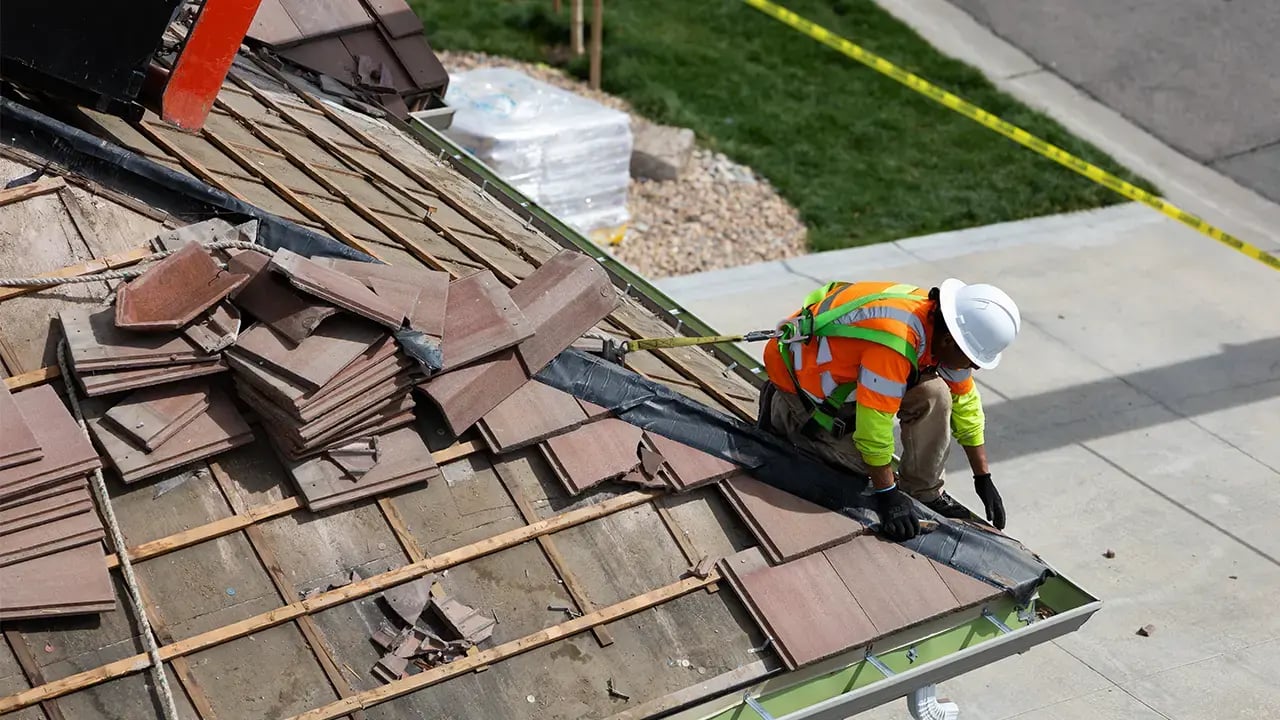
- Tear-off of existing material, including any additional layers, plus dumpster placement and landfill disposal fees.
- Decking inspection and replacement of damaged or non-compliant sheathing.
- Ice and water barrier at eaves, valleys, and penetrations.
- Synthetic underlayment across the field.
- Drip edge, valley metal, step and counter flashing, chimney and wall flashing.
- Pipe boots, roof vents, and any swamp cooler, skylight, or solar detail work.
- Shingles or panels, ridge cap, and starter course.
- Balanced attic ventilation, intake and exhaust, which the code addresses and which directly affects shingle lifespan.
- Permit fees and code inspections.
- Labor, including the burden of workers compensation, liability coverage, and safety equipment.
- Magnetic sweep, cleanup, and property protection.
- Warranty registration and manufacturer certification requirements, which for systems like the Owens Corning Platinum warranty carry specific installation standards.
Some estimates in the Colorado market do not include permits, delivery, or work around roof penetrations. Confirming what is inside the number is more useful than comparing the number itself.
What a Colorado roof costs in 2026
Roofing is priced by the square, which equals 100 square feet of roof surface. The figures below reflect the Colorado market and are shown both per square foot and per roofing square, along with what they work out to on a 30 square roof, which is roughly 3,000 square feet of roof surface and close to the regional average.
Asphalt shingle systems, installed
|
System |
Impact Rating |
Per Square Foot |
Per Square (100 sq ft) |
30-Square Roof |
|
Owens Corning Oakridge |
Class 3 |
$5.85 to $6.00 |
$585 to $600 |
$17,550 to $18,000 |
|
Owens Corning Duration |
Class 3 |
$6.50 to $7.30 |
$650 to $730 |
$19,500 to $21,900 |
|
Owens Corning Duration Storm |
Class 4 |
$7.00 to $8.00 |
$700 to $800 |
$21,000 to $24,000 |
|
Owens Corning Duration Flex |
Class 4 |
$7.50 to $8.25 |
$750 to $825 |
$22,500 to $24,750 |
|
CertainTeed Presidential |
Class 3 |
$10.00 to $12.00 |
$1,000 to $1,200 |
$30,000 to $36,000 |
|
CertainTeed Presidential IR |
Class 4 |
$7.25 to $11.50 |
$725 to $1,150 |
$21,750 to $34,500 |
Premium and synthetic systems, installed
|
System |
Impact Rating |
Per Square Foot |
Per Square (100 sq ft) |
30-Square Roof |
|
Concrete tile |
Class 4 |
About $12.75 |
About $1,275 |
About $38,250 |
|
Stone-coated steel, direct to deck |
Class 4 |
About $13.00 |
About $1,300 |
About $39,000 |
|
Standing seam metal, snap lock |
Class 4 |
About $13.50 |
About $1,350 |
About $40,500 |
|
DaVinci synthetic |
Class 4 |
About $20.00 |
About $2,000 |
About $60,000 |
|
Brava roof tile |
Class 4 |
About $21.50 |
About $2,150 |
About $64,500 |
Two notes on these ranges. First, roof complexity moves the number as much as material choice does. Steep pitch, multiple valleys, dormers, skylights, and difficult access all add labor hours to the same square footage. Second, many homeowners spend an additional $5,000 or more on related work discovered during the project, such as gutters, skylight replacement, electrical adjustments, or decking repair. Budgeting only for the shingle line item is the most common planning mistake in a Colorado roof replacement.
Why the lowest bid is rarely the cheapest roof
When two estimates for the same house differ by several thousand dollars, the gap almost never comes from one company being more efficient. It usually comes from one of four places: the scope leaves out code-required items, the decking allowance assumes no damage will be found, the labor is subcontracted to the lowest available crew, or the company is not carrying the insurance and warranty obligations that the other one is.
Installation quality is the single largest variable in whether a roof reaches its rated lifespan. In a climate that combines hail, high wind, ultraviolet exposure, and freeze-thaw cycling, a poorly fastened or improperly flashed roof does not fail gracefully. It fails at the first serious storm, often outside of what a manufacturer warranty will cover, because most warranty denials trace back to installation error rather than product defect.
6 ways Colorado homeowners can control the cost
- Request an itemized scope rather than a bottom-line number. Every estimate should specify underlayment type, ice barrier coverage, flashing details, ventilation, decking allowance, permit handling, and disposal.
- Ask which line items are driven by code in the specific jurisdiction. A contractor who cannot answer that question for the city the home sits in is not the right contractor for a Colorado reroof.
- Price impact-resistant material against the insurance discount. Class 4 systems typically carry a premium over standard architectural shingles, and many Colorado carriers offer premium credits that recover part of that difference over the life of the roof. The math is worth running with the actual carrier rather than assuming either way.
- Read the declarations page before storm season, not after. The deductible structure, whether the roof is covered at replacement cost or actual cash value, and whether a roof payment schedule applies are the three details that determine out-of-pocket exposure. Homeowners usually discover them at the worst possible moment.
- Plan for decking honestly. On older homes it is not unusual to replace a meaningful share of the decking once the old material comes off. An estimate with a realistic decking allowance is more useful than one that assumes perfect sheathing.
- Use financing rather than deferring the work. Deferred roof replacement in Colorado tends to compound into decking damage, interior damage, and insurability problems. Consider working with your local credit union to get a HELOC loan to fund the project. HELOCs tend to have better rates and allow for more flexibility in financing large home projects.
Frequently asked questions
Why does roofing cost more in Colorado than the national average?
Colorado combines national material and labor inflation with the highest large hail frequency in North America, intense high-altitude ultraviolet exposure, wide freeze-thaw swings, and local building codes that require ice barrier, high wind fastening, and decking corrections on most reroofs. Roofs also fail sooner here, which increases replacement frequency on top of the higher per-project cost.
How much does a roof replacement cost in Colorado in 2026?
Most asphalt shingle replacements fall between $650 and $825 per square installed, which is $6.50 to $8.25 per square foot. On a typical 30 square roof, that works out to roughly $19,500 to $24,750. Premium systems such as tile, metal, slate, and synthetic run from about $1,200 to over $2,300 per square installed.
Will roofing prices go down in 2027?
There is no strong evidence pointing that direction. Manufacturers raised prices in 2026 even as demand fell, choosing to curtail production rather than discount, and tariff-driven input costs have historically not reversed once imposed. Planning around a future price drop is a weaker strategy than planning around current pricing.
Are impact-resistant shingles worth the extra cost in Colorado?
For most Front Range homes, the question is worth running with real numbers. Class 4 impact-rated systems carry a material premium but many carriers offer premium credits, and a roof that survives a moderate hail event without a claim avoids both the deductible and the claim history that affects future insurability.
Why do two estimates for the same roof differ by thousands of dollars?
Usually because the scopes are different. Common omissions include ice and water barrier, drip edge, decking replacement allowance, permit fees, ventilation upgrades, and work around penetrations such as skylights and swamp coolers. Comparing itemized scopes side by side resolves most of the gap.
Does insurance cover the full cost of a hail-damaged roof?
It depends on the insurance policy. A replacement cost policy pays the depreciated amount first and releases the withheld depreciation after the work is completed and invoiced, leaving the homeowner responsible for the deductible. An actual cash value roof endorsement or roof payment schedule pays only the depreciated value, which can leave a substantial gap on an older roof.
The bottom line for Colorado homeowners
A roof in Colorado is not expensive because contractors decided it should be. It is expensive because national material markets, a shrinking skilled labor pool, the most active hail corridor on the continent, jurisdiction-specific code requirements, and a restructured insurance market all landed on the same project at the same time. Understanding which of those forces is driving a given line item is what turns an intimidating estimate into a decision a homeowner can make with confidence.
Excel Roofing has been serving Colorado and Wyoming homeowners since 1993 and has completed more than 55,000 roofing projects across the region. Every estimate comes with a clear, itemized scope of work so homeowners can see exactly what they are paying for and why. You Don’t Pay A Cent Until You’re Content.
Schedule a free inspection and written estimate at excelroofing.com, or call the Englewood office at (303) 761-6400.
Sources and further reading
Rocky Mountain Insurance Information Association hail loss data; Colorado Division of Insurance and Colorado Sun reporting on 2026 homeowners premiums; Asphalt Roofing Manufacturers Association Q1 2026 shipment data; Owens Corning quarterly earnings disclosures; Associated Builders and Contractors 2026 and 2027 workforce projections; U.S. Bureau of Labor Statistics construction wage data; Associated General Contractors construction input price data; manufacturer price increase announcements from GAF, Owens Corning, CertainTeed, Atlas, and TAMKO; 2021 International Residential Code as adopted with local amendments across Front Range jurisdictions; Colorado Revised Statutes 6-22-101 through 6-22-105; Excel Roofing Colorado Roofing Cost Guide, updated August 2026.






%20(1).webp?width=301&height=630&name=Roof-Inspection-Tile-Photo%20(1)%20(1).webp)
