
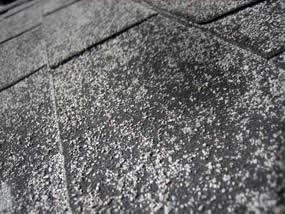
How Can I Tell if I Have Roof Damage?
After a Colorado or Wyoming storm rolls through, the question on every homeowner's mind is whether the roof took a hit. The tricky part is that hail damage is often invisible from the ground. A roof can look perfectly fine from the driveway while the shingles above are quietly compromised. Here is how to read the signs, starting from the ground and working up.
Start From the Ground
You do not need to climb anything to gather the first round of clues. After a hailstorm, walk the yard and look over the exterior of the house:
-
Down leaves and branches. A fresh carpet of shredded leaves and small branches is one of the clearest signs a neighborhood just took a serious hit.
-
Dented gutters and downspouts. Hail leaves dents in soft metals. If your aluminum gutters and downspouts are dimpled, your roof very likely caught the same impacts. Inspectors actually use this as a tell. If the soft metals are clean, the roof often is too.
-
Granules in the downspouts. Look for sandy shingle granules washing out onto the driveway or grass. That is the protective surface of your shingles coming off.
-
Torn window screens and cracked shutters. Screens punched through and plastic shutters that are split or shattered point to hard, fast hail.
-
Siding and window damage. Impact marks on siding, and broken or cracked windows, are strong indicators. Broken car windows in the area almost guarantee roof damage on an asphalt shingle home.
-
Roofers suddenly working the neighborhood. Not scientific, but if crews are swarming your street, the storm did real damage.
One thing to keep in mind: hail comes in from a direction. Depending on whether the storm drove in from the north, south, east, or west, one side or elevation of your house may be hammered while another looks untouched. Check the exposed elevations specifically.
Size Is Not the Whole Story
It is tempting to assume bigger hail means worse damage, but density and wind matter just as much. Soft, white hail tends to crush or dissipate on impact and may do little harm even at larger sizes. Harder, clear or blue tinted hail hits like a stone. Add wind, and a smaller wind driven stone can do more damage than a big, fluffy one. Two inch soft hail might leave your roof fine, while solid half inch to one inch wind driven hail causes real bruising. In Colorado, storms tend to bring exactly that combination of solid, wind driven hail, which is part of why the Front Range sees so many claims.

What Damage Looks Like Up on the Roof
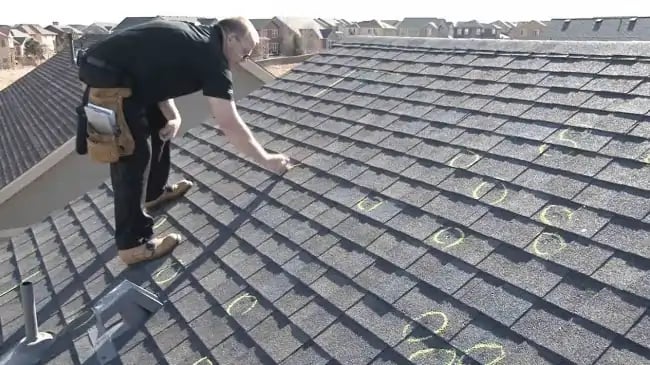
This part is best left to a professional, both for safety and because trained eyes catch what homeowners miss. Here is what an inspector looks for on an asphalt shingle roof:
-
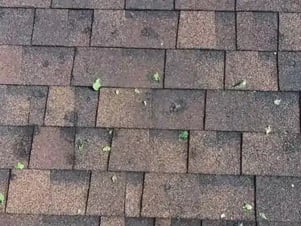
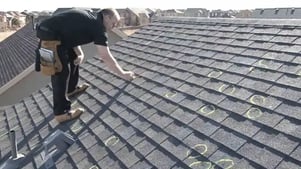
Bruises. A hail bruise shows up as a dark, roughly circular spot where the granules have been knocked away and the asphalt mat underneath is exposed. Press a finger into it and it often feels soft or spongy, like a bruise on a piece of fruit. Pull your finger back and you may pick up loose granules.
-
A random, varying pattern. Real hail damage is scattered across the slope with marks of different sizes, rather than appearing in neat, uniform clusters.
-
Collateral damage. The same dents you saw on the gutters usually show up on roof vents, flashing, and other soft metals.
Hail Bruise or Heat Blister?
One of the most common mix ups is confusing a hail bruise with a heat blister, and the difference matters for both repairs and insurance.
A heat blister forms from the inside out. Trapped moisture or heat, often from poor attic ventilation, creates a small bubble in the shingle that eventually pops, leaving a small, defined pit. Blisters tend to be small, uniform, and clustered, and the mat underneath is not bruised or soft.
A hail hit comes from the outside in. The impacts are random in size and placement, the spot feels soft because the mat itself has been bruised, and the damage shows up alongside dents on gutters and other soft metals. Inspectors also tend to find hail bruises out in the open field of the shingle rather than along the edges, since the unsupported center of the exposed tab is more vulnerable.
If you are squinting at a mark trying to decide which it is, that uncertainty is exactly why a professional inspection is worth it.
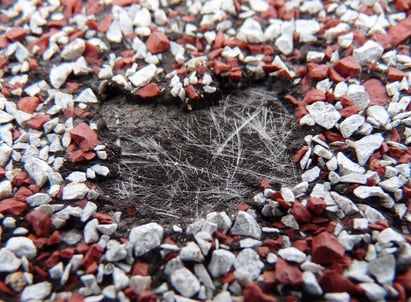
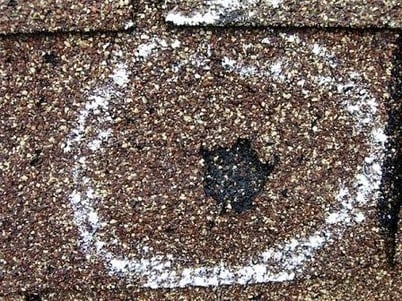
Heat blister vs hail damage
When in Doubt, Get It Inspected
Because hail damage hides so well, the safest move after any significant storm is a professional roof inspection. Damage left alone costs you granules, shortens the life of the roof, and can eventually turn into leaks. Waiting too long can also complicate an insurance claim.
At Excel Roofing, we have been inspecting and repairing storm damaged roofs across the Denver metro, Colorado Springs, Casper, and Sheridan since 1993. We will give you a straight answer on whether you have damage worth filing on. We are on top of it, and you do not pay a cent until you are content.
Sources
-
Evolve Construction, Identifying Hail Damage on Asphalt Shingles: https://evolveconstruction.com/blog/identifying-hail-damage-on-asphalt-shingles guide/
-
Exterior Alliance, Roof Blistering vs Hail Damage: https://exterioralliance.com/uncategorized/roof-blistering-vs-hail-damage/
-
Insurance Institute for Business and Home Safety, hail research: https://ibhs.org/hail/relative-impact-resistance-of-asphalt-shingles/
Topics: