
Attic ventilation is the part of a roofing system almost no homeowner thinks about, and it is one of the biggest factors in how long a roof actually lasts. Most people shop for a roof by looking at shingle color, warranty length, and price. Very few ask what is happening in the air space directly beneath those shingles.
In a recent Excel Roofing video, J Bretz, who has spent 33 years in Colorado roofing, put that question to Octavian Avila, Regional Sales Leader for the Mountain Region at Owens Corning. Before joining Owens Corning nearly a decade ago, Avila spent roughly five years working specifically in the attic ventilation industry. His answer was direct.
"It is vital. It is the lungs of the roofing system."
That comparison is worth unpacking, because it explains almost everything a homeowner needs to know about why ventilation matters.
The Short Answer
Attic ventilation is critical to the life of a roof. A properly ventilated attic continuously exchanges air, which pulls moisture out of the attic before it can be absorbed by insulation, keeps attic temperatures closer to outdoor temperatures, and prevents the heat and humidity cycle that ages shingles from underneath. An attic that cannot breathe invites mold, degrades insulation, and shortens shingle life while making the upstairs of a home noticeably less comfortable.
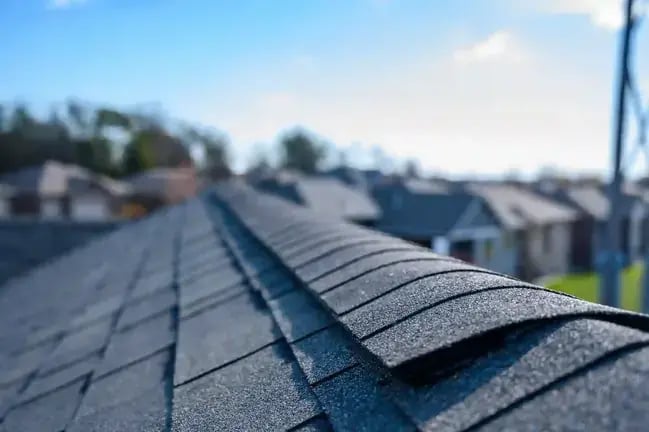
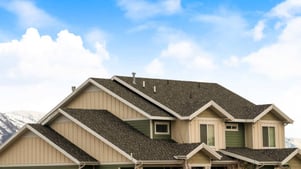
Ridge vents at the top of the roof allow heat and moisture to flow out of the attic
Why an Attic Needs to Breathe
Everyday living generates a surprising amount of water vapor. Cooking, showering, laundry, dishwashing, and simply breathing all release moisture into the air inside a home. That moisture rises, and much of it ends up in the attic.
Avila described what happens next in terms most homeowners recognize immediately. Attic insulation behaves like a sponge. It absorbs the moisture that collects around it. If the attic is ventilated, that moisture is carried out and the insulation dries on a consistent cycle. If the attic is not ventilated, the sponge never wrings out.
A permanently damp attic creates several problems at once:
- Mold growth on sheathing, framing, and insulation
- Insulation that loses its ability to insulate once it is saturated
- Wood decking that softens and loses fastener holding strength over time
- Rust and corrosion on nails, fasteners, and metal flashing
None of these problems announce themselves. They develop quietly, above the ceiling, over a period of years. By the time a homeowner notices staining or a musty smell, the damage usually already done.
Heat, Insulation, and Premature Shingle Failure
Ventilation is not only about moisture. It is also about temperature.
As Avila explained, proper ventilation keeps attic temperature where it is supposed to be, which in turn lets insulation do what it was designed to do. Insulation is engineered to slow heat transfer, not to sit in a superheated, humid box. When attic temperatures spike and stay there, the entire assembly works against itself.
Shingles feel that heat from both directions. They absorb solar heat on the surface and, in an unventilated attic, they get cooked from below as well. Sustained high temperatures accelerate the aging of asphalt shingles, which is what Avila referred to as early fatigue. The roof does not fail dramatically. It simply wears out years ahead of schedule.
"For the roof to not get early fatigue and to not die out quicker, you definitely want to have proper ventilation."
This is also why ventilation and warranty coverage are connected. Shingle manufacturers design their products around the assumption that the attic beneath them meets code-required ventilation. When a roof is installed over an attic that does not, the manufacturer is being asked to stand behind a product operating outside the conditions it was engineered for. Any homeowner reviewing a shingle warranty should read the ventilation language closely.
Why the Upstairs Is Always Hotter
Most homeowners have experienced the familiar summer pattern where the main floor is comfortable and the second floor is miserable. J Bretz raised that point directly, and Avila confirmed it is often a ventilation issue rather than an air conditioning issue.
When superheated air has nowhere to go, it stacks up in the attic and radiates down through the ceiling into the rooms below. Improving ventilation reduces that heat load, which makes upstairs bedrooms more comfortable and takes some of the strain off the cooling system. It is not a replacement for good insulation or a properly sized air conditioner, but it addresses a source of heat that neither of those can fully overcome on its own.
What Proper Ventilation Actually Looks Like
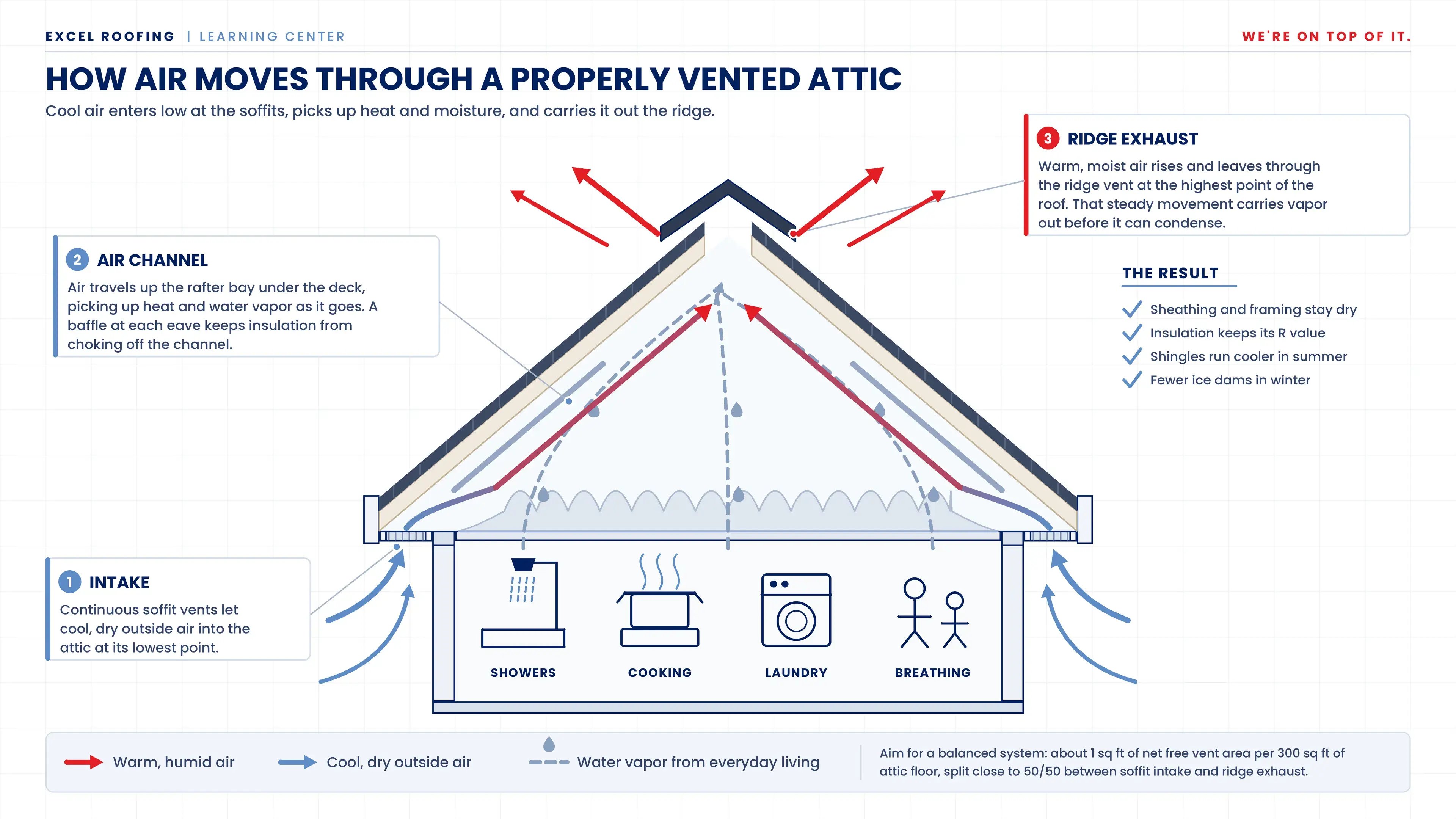
A ventilation system needs two halves to function. Air has to enter and air has to exit. A roof with exhaust vents but blocked or missing intake is not a ventilated roof, and this is one of the most common defects found during inspections.
Intake
Intake ventilation is usually located at the eaves, through soffit vents or edge vents. Cool outside air enters here. Intake is very often compromised by insulation that has been pushed into the eaves during an insulation upgrade, or by soffit vents that were painted over.
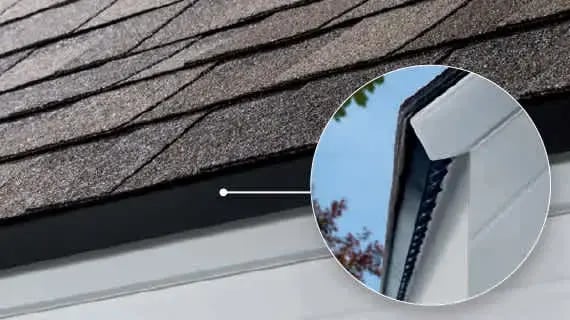
Owens Corning VentSure InFlow Vent
Exhaust
Exhaust ventilation sits at or near the ridge. Warm, moist air rises and leaves the attic here. Ridge vents, box vents, and powered vents all serve this role, though mixing different exhaust types on a single roof plane can cause one to short circuit the other and pull air from the wrong direction.
How Much Is Needed
Residential building code sets the baseline. The general requirement is one square foot of net free ventilation area for every 150 square feet of attic floor. That ratio can be reduced to one square foot per 300 square feet when a vapor retarder is present on the warm side of the ceiling and the ventilation is balanced roughly evenly between intake and exhaust. Local amendments apply, so the governing number is whatever the jurisdiction has adopted.
The math matters less to a homeowner than the principle behind it. Ventilation should be balanced, unobstructed, and sized to the attic it serves.
Ventilation in Colorado and Wyoming Specifically
Front Range and mountain region climates put unusual demands on a roof. Ventilation carries extra weight here for a few reasons.
- Wide daily temperature swings drive repeated condensation cycles in the attic, particularly in shoulder seasons
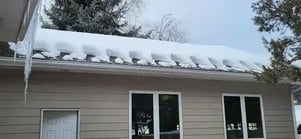
- Winter ice damming is driven largely by warm attic air melting snow on the roof deck, which then refreezes at the colder eave, and ventilation is a primary defense
- High altitude means more intense ultraviolet exposure on the shingle surface, so adding heat stress from below compounds an already aggressive aging environment
- Dry indoor winters lead many households to run humidifiers, which increases the moisture load an attic has to shed
A ventilation strategy that works fine in a mild, humid climate is not automatically adequate at 5,280 feet.
Signs of an Attic Ventilation Problem
Homeowners can spot several of the warning signs without going into the attic:
- Second floor rooms run significantly hotter than the rest of the house in summer
- Ice dams or large icicles form along the eaves in winter
- Cooling bills climb without a corresponding change in usage
- A musty odor appears near ceiling vents or the attic access
- Frost or condensation shows on the underside of the roof deck in cold weather
- Shingles cup, curl, or blister well before the warranty period ends
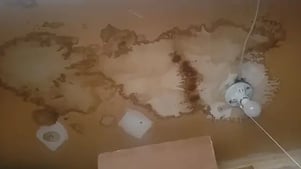
- Ceiling paint stains or peels with no plumbing leak to explain it
Any one of these justifies an inspection. Several together usually confirm the diagnosis.
What to Look For When Hiring a Contractor
Asked what consumers should look for when choosing a contractor and a roofing product, Avila offered two markers.
The first is the Owens Corning Platinum Preferred badge. Platinum Preferred is the highest tier in the Owens Corning contractor network and represents roughly the top one percent of roofing contractors nationally. Excel Roofing has held that designation since 2012, and J Bretz serves on the Owens Corning Platinum Advisory Board, which provides manufacturer feedback on market conditions and product direction from the contractor side.
The second is a Class 4 impact rating on the shingle itself. Class 4 is the highest rating in the UL 2218 impact resistance standard, and in hail-prone regions like Colorado and Wyoming it is the practical baseline rather than an upgrade. Many insurance carriers offer premium discounts for Class 4 roofing, which is worth a call to an agent before selecting a product.
J Bretz added two more standards from the contractor side. A homeowner should never pay anything until the work is complete and they are satisfied with it, and a homeowner should never sign a roofing contract that carries cancellation fees.
Frequently Asked Questions
How important is attic ventilation to a roof?
It is critical. Attic ventilation directly affects how long shingles last, whether moisture accumulates in the attic, and how well insulation performs. An unventilated attic traps heat and humidity against the underside of the roof deck, which ages shingles prematurely and can void portions of a manufacturer warranty.
What happens if an attic is not properly ventilated?
Moisture from cooking, showering, and laundry accumulates in attic insulation instead of drying out. Attic temperatures rise well above outdoor temperatures. The combination promotes mold growth, degrades insulation performance, corrodes fasteners, and shortens shingle life.
Can poor attic ventilation cause mold?
Yes. Mold requires moisture, and an attic that cannot exchange air holds the moisture that everyday household activity pushes upward. Insulation absorbs that moisture and holds it against wood framing and sheathing, which creates the conditions mold needs to establish.
Does attic ventilation lower cooling costs?
It can help. Ventilation reduces the volume of superheated air sitting above the ceiling, which lowers the heat radiating into upstairs rooms and reduces the load on the air conditioning system. It works alongside insulation rather than replacing it.
How much attic ventilation does a home need?
Building code generally requires one square foot of net free ventilation area per 150 square feet of attic floor space. That ratio can be reduced to one per 300 square feet when a vapor retarder is installed on the warm side of the ceiling and intake and exhaust are balanced. Local amendments govern, so the adopted local code determines the requirement.
Does attic ventilation matter in winter?
Yes, and in Colorado and Wyoming it may matter more. Warm attic air melts snow on the roof deck, which refreezes at the colder eave and forms ice dams. Ventilation keeps the deck closer to outdoor temperature, which reduces that melt and refreeze cycle. Ventilation also removes the winter moisture load from indoor humidifiers.
What is an Owens Corning Platinum Preferred Contractor?
Platinum Preferred is the highest tier of the Owens Corning contractor network, held by roughly the top one percent of roofing contractors nationwide. The designation requires meeting standards for licensing, insurance, credit, and customer satisfaction, and it unlocks extended system warranty options. Excel Roofing has been Platinum Preferred since 2012.
What is a Class 4 shingle and does it matter in Colorado?
Class 4 is the highest impact resistance rating under the UL 2218 standard, which measures how a shingle withstands impact from hail-sized objects. In Colorado and Wyoming hail country it is the practical standard rather than an upgrade, and many insurance carriers offer premium discounts for Class 4 roofing systems.
Get Your Attic Inspected
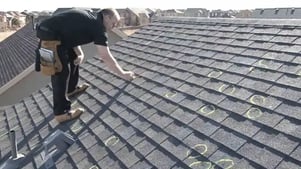
Ventilation problems are invisible from the driveway and rarely obvious from inside the house. A roof inspection that includes the attic will identify blocked intake, undersized exhaust, moisture staining, and insulation issues before they turn into a premature roof replacement.
Excel Roofing has served Colorado and Wyoming homeowners since 1993, with offices in Englewood and Colorado Springs, Colorado, and Sheridan and Casper, Wyoming. Inspections are free and there is no obligation attached to them.
Schedule a free roof and attic inspection at excelroofing.com
You Don't Pay A Cent Until You're Content. We're On Top Of It.
Topics:



.webp?width=301&height=365&name=The%20Taylors%20with%20Adam%20Omernick%20after%20their%20roof%20had%20been%20fully%20replaced%20(1).webp)
%20(1).webp?width=301&height=630&name=Roof-Inspection-Tile-Photo%20(1)%20(1).webp)


.webp?width=301&height=425&name=navigating-the-insurance-claims-process-for-hail-damaged-roofs%20(1).webp)
.webp?width=301&height=210&name=tipping-a-contract%20(1).webp)