
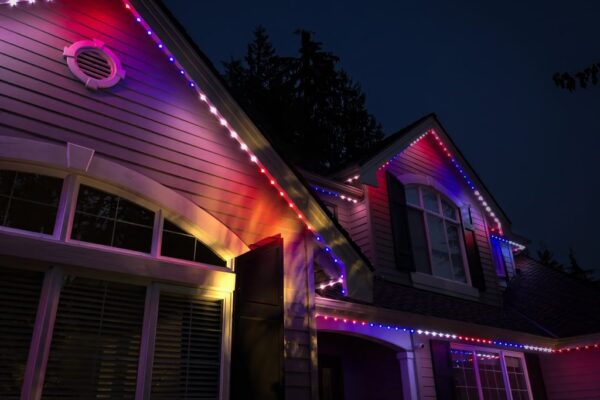
Permanent holiday lights are worth the cost for most homeowners who already pay for seasonal light installation or who plan to use the lights beyond December. A professionally installed system typically costs $20 to $40 per linear foot, consumer DIY kits run about $3 to $6 per linear foot, and many homeowners who switch from yearly installers break even in roughly four to five years. After that, the lights keep working year round for holidays, game days, and everyday accent lighting.
Excel Roofing, a Colorado and Wyoming roofing contractor since 1993, installs professional permanent lighting systems on homes across the Front Range and Wyoming. This guide answers the questions homeowners ask most before they buy, from cost and daytime appearance to cold-weather durability and what happens when a single light fails.
Key Takeaways
- Professional permanent lighting typically costs $20 to $40 per linear foot installed; DIY kits typically cost $3 to $6 per linear foot.
- Quality systems mount in a low-profile rail on the fascia that is nearly invisible during the day.
- Commercial-grade LEDs are commonly rated for around 50,000 hours of use.
- On a well-designed system, one failed light does not darken the whole roofline, and a single light or section can be replaced.
- Lights should mount to the fascia, never to the gutters.
What Do Permanent Holiday Lights Look Like During the Day?
With a quality system, permanent holiday lights are barely noticeable during the day. Professional systems run the lights through a low-profile rail mounted under the roof edge and color-matched to the home's trim. The wiring stays inside the rail, so there are no hanging cords and no clips attached to the shingles. From the street, most neighbors never notice the system is there.
Lower-cost systems that use exposed clips, adhesive pucks, or visible wiring between lights are more noticeable in daylight. This is the most common concern from homeowners associations, and the rail-mounted approach is usually the one HOAs are most comfortable approving.
Can Permanent Holiday Lights Be Used All Year?
Yes. Because every light is individually programmable, permanent lighting works all year, not just at Christmas. Common uses include:
- Everyday architectural accent: soft warm white downlighting that makes a home look finished at night.
- Security lighting: bright white over driveways and entries.
- Holidays: green, purple, and orange for Halloween; red, white, and blue for the Fourth of July.
- Game days: team colors for a big game.
This year-round value is a major part of the return on investment. A traditional string light setup is used for a few weeks each year. A permanent system can be used every night.
How Much Do Permanent Christmas Lights Cost Per Foot?
Professionally installed permanent Christmas lights typically cost $20 to $40 per linear foot, while consumer DIY kits typically cost $3 to $6 per linear foot. The professional price usually includes commercial-grade lights, the mounting rail, the controller, and installation labor.
|
Option |
Typical Cost |
What Is Included |
|
Professional permanent system |
$20 to $40 per linear foot |
Commercial-grade lights, mounting rail, controller, and installation |
|
DIY permanent kit (such as Govee) |
$3 to $6 per linear foot |
Lights, clips or adhesive mounts, and app; labor is the homeowner's |
|
Traditional seasonal installer |
Paid every season |
Hanging, removal, and often light rental, repeated each year |
Final cost depends on the length of the roofline, the number of stories, the complexity of corners and peaks, and where the controller and power supply need to go.
Are Permanent Holiday Lights Worth the Cost?
For homeowners who already hire a seasonal installer, permanent lights usually pay for themselves within a few years. Consider an example home with 150 feet of roofline. At $30 per linear foot, a professional permanent system costs about $4,500 once. If that homeowner pays a traditional installer about $1,000 each season, the system breaks even in roughly four and a half years.
That calculation counts Christmas only. It does not include the value of Halloween displays, game-day colors, or everyday accent and security lighting, which traditional seasonal lights cannot provide.
For homeowners who hang their own lights, the savings come from time and safety instead of installer fees: no more weekends on a ladder in November and again in January.
How Do You Install DIY Permanent Outdoor Lights?
A typical DIY installation follows these steps:
- Measure every run of the roofline, including corners and peaks.
- Plan the location of the controller and power supply, usually in the garage or attic near an outlet.
- Mount the lights along the roof edge using the kit's clips, adhesive mounts, or track.
- Connect each section with the included jumper and extension cables.
- Route the power wire into the garage or attic and pair the controller with the app.
The reality is harder than the instructions suggest. DIY installation means hours on a ladder, often two stories up. Keeping a perfectly straight line is difficult, and crooked sections show clearly once the lights are on. Runs rarely match the kit lengths, which leads to extra extension cables, and routing wire into the home cleanly takes careful planning.
Professional Installation vs DIY Permanent Lights: Which Is Better?
Professional systems are better for long-term durability and appearance, while DIY kits are better for tight budgets and simple, single-story rooflines. The biggest difference is how the lights are mounted.
|
Factor |
Professional System |
DIY Kit |
|
Mounting |
Continuous rail fastened to the fascia |
Plastic clips or adhesive pucks, often |
|
Daytime look |
Rail covers wiring; nearly invisible |
Lights and wires often visible |
|
Alignment |
Rail keeps every light straight |
Depends on the installer's precision |
|
Weather exposure |
Lights and wiring shielded by the rail |
Adhesive and plastic exposed to sun and freeze cycles |
|
Repairs |
Handled by the installer |
Homeowner on the ladder |
|
Upfront cost |
$20 to $40 per linear foot |
$3 to $6 per linear foot |
In climates like Colorado and Wyoming, where homes see intense sun, freezing nights, and large temperature swings, plastic clips can become brittle and adhesive can let go over time. That is when sagging lights and loose wires start to appear.
Should Permanent Lights Be Mounted on Gutters?
No. Permanent lights should be mounted on the fascia, the solid trim board behind the gutter, not on the gutters themselves. Gutters flex, fill with ice, and are regularly cleaned, repaired, or replaced, all of which can damage lights attached to them. Fascia mounting is also the cleanest look and the option most HOAs prefer.
How Do You Power and Control Permanent Lights?
Most permanent lighting systems run from a single controller plugged into a standard outlet in the garage or attic, which then connects to a smartphone app. From the app, homeowners can choose colors, build patterns, and set schedules so the lights turn on at sunset and off at a set time automatically. Some systems also connect to smart home platforms and voice assistants.
Lighting apps have a learning curve. Professional installers typically set up everyday scenes and holiday presets before leaving, so homeowners can start with a few taps and explore more options over time.
How Long Do Permanent LED Holiday Lights Last?
Commercial-grade LEDs are commonly rated for around 50,000 hours. Even running every night of the year, that represents well over a decade of use, and most homeowners do not run their lights all night. The LEDs themselves are rarely what fails first. On lower-cost systems, the weak points are usually the adhesive, clips, connectors, and seals.
Are Permanent Holiday Lights Waterproof and Durable in Freezing Weather?
Quality permanent lights are sealed against rain and snow and rated for outdoor temperatures well below freezing. Homeowners comparing systems should check the product's weather rating and pay close attention to the connectors between sections, since that is where water most often gets in. Rail-mounted systems add another layer of protection by shielding the lights and wiring from direct snow, ice, and sun.
What Happens If One Light Burns Out on a Permanent System?
On a well-designed permanent system, one failed light does not take down the rest of the roofline. Because the lights are modular, a single light or short section can be replaced without replacing the entire system. With a professional installation, that repair is a service call, so no one in the household needs to climb a ladder in the middle of winter.
With DIY kits, the answer depends on the product. Some allow a single section to be swapped, while others require replacing a full strand.
Who Should Choose Professional, DIY, or Traditional Lights?
- Professional permanent lighting: Homeowners who plan to stay several years, already pay for seasonal installation, want a clean daytime look, or want to use the lights year round.
- DIY permanent kits: Homeowners comfortable on a ladder with a single-story home or simple roofline and a tighter budget.
- Traditional string lights: Homeowners who decorate only a few weeks a year, prefer the classic look of large bulbs, or may move within a year or two.
Frequently Asked Questions
Are permanent holiday lights worth it?
For most homeowners who pay a seasonal installer or want year-round lighting, yes. Many break even in about four to five years.
How much do permanent Christmas lights cost per foot?
Professional systems typically cost $20 to $40 per linear foot installed. DIY kits typically cost $3 to $6 per linear foot.
Can permanent lights stay up all year?
Yes. They are designed to stay installed permanently and can be used for holidays, game days, security, and everyday accent lighting.
Do permanent lights damage the roof or gutters?
Professionally installed systems mount to the fascia, not the shingles or gutters, which protects the roof and gutter system.
How long do permanent LED lights last?
Commercial-grade LEDs are commonly rated for around 50,000 hours, which is well over a decade of typical use.
What happens if one light stops working?
On a quality modular system, the rest of the lights stay on, and the failed light or section can be replaced individually.
Get a Free Permanent Lighting Estimate
Excel Roofing installs professional permanent lighting systems for homes in Colorado and Wyoming, mounted to the fascia with a covered rail so no wires show. Every estimate includes measuring the home, a clear price, and setup of favorite scenes after installation. Financing is available, visit our financing page for more information.
To see what permanent lighting would look like on a home, schedule a free estimate at excelroofing.com.